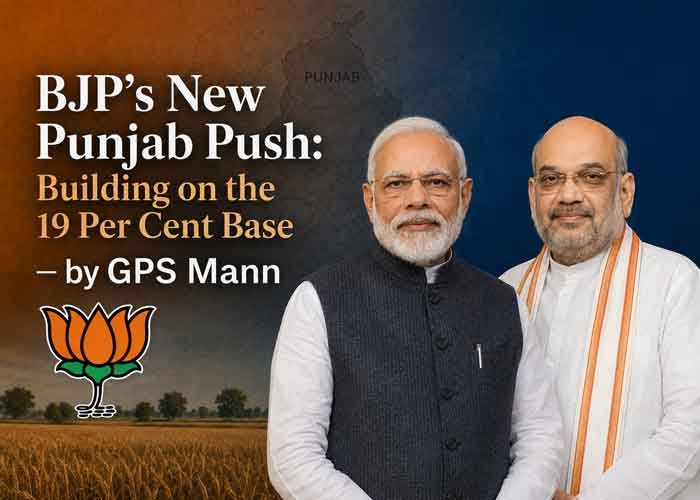
The Bharatiya Janata Party appears to have shifted into election mode in Punjab, with a series of organisational appointments signalling a more structured attempt to prepare for the 2027 Assembly polls.
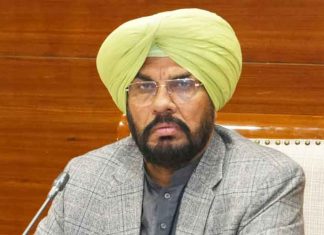
Kewal Singh Dhillon was appointed Punjab BJP president in May. The subsequent reorganisation of district and state office-bearers, however, triggered resentment among sections of the traditional cadre, with some workers objecting to the prominence given to leaders who entered the party from other political formations.
The BJP high command has now moved to strengthen the Punjab team. Manpreet Singh Badal has been appointed a national vice-president, while Rajasthan leader Satish Poonia has been made Punjab in-charge. Union Jal Shakti Minister and former Gujarat BJP president C. R. Paatil is also reported to be the likely election in-charge, although that appointment has not been formally announced.
The emerging arrangement brings together a Jat Sikh state president, an experienced organisational strategist, a Punjab leader with political and economic experience and, potentially, a high-energy election manager. It is a formidable combination, but multiple centres of influence will work only if responsibilities and authority are clearly defined.
The urgency is understandable. The BJP won 18.56 per cent of the vote in Punjab in the 2024 Lok Sabha election, polling around 25 lakh votes and leading in 24 Assembly segments. Yet it failed to win any of the state’s 13 parliamentary seats. The result was the party’s strongest statewide vote-share performance but also demonstrated the limitations of a geographically uneven support base.
At a rally in Moga in March 2026, Union Home Minister Amit Shah said that wherever the BJP reaches 19 per cent, it forms the next government. For a party that was historically the junior partner to the Shiromani Akali Dal in Punjab, the assertion was significant.
But 19 per cent is a foundation, not a guarantee of 59 Assembly seats.
The BJP’s 2024 vote was secured in a Lok Sabha election fought amid a strong national Modi factor, with the party contesting independently after ending its alliance with the SAD. An Assembly election will be a different contest, driven more heavily by candidates, local organisations, rural networks, community equations and state-level leadership.
An early People’s Pulse survey, Mood Punjab Da, offers one indication of the political landscape, though it should be treated as a snapshot rather than a forecast. The survey puts the AAP at 37 per cent, Congress at 31 per cent, Waris Punjab De at 14 per cent, BJP at 8 per cent and SAD at 6 per cent. It projects 58-63 seats for AAP, 36-43 for Congress, 4-7 for Waris Punjab De, 2-6 for BJP and 2-4 for SAD.
The survey says it conducted 8,000 face-to-face interviews across all 117 constituencies between June 20 and July 31. Its methodology and fieldwork cannot be independently verified here. More importantly, the survey predates the August 7 mobilisation of government employees and pensioners over pending 18 per cent dearness allowance, the Old Pension Scheme and other demands. Any subsequent change in public sentiment would therefore not be captured in those figures.
The survey’s leadership numbers are also revealing. Chief Minister Bhagwant Mann leads the preferred-chief-minister category with 40 per cent, followed by Congress leader Charanjit Singh Channi at 33 per cent, Amritpal Singh at 13 per cent, Sukhbir Singh Badal at 5 per cent and Kewal Singh Dhillon at 4 per cent.
For Congress, Channi’s popularity remains an important political asset. The party’s challenge is to translate that personal appeal into a coherent leadership proposition and a statewide electoral organisation.
For the BJP, the immediate challenge is internal consolidation. Its Punjab unit now brings together three distinct political cultures: the traditional urban BJP cadre, former Congress leaders and leaders with roots in the Akali establishment.
Expansion inevitably requires new faces, but growth cannot come at the cost of alienating the workers who built the organisation. New entrants can bring networks, visibility and resources; the old cadre provides loyalty and booth-level organisation. The BJP needs both.
Sunil Jakhar’s role also cannot be overlooked. Under his presidency, the party recorded its highest statewide vote share and led in 24 Assembly segments in the 2024 Lok Sabha election. His presence helped the BJP reach beyond its traditional urban support base. Whatever the rationale for replacing him with Dhillon, the party would be unwise to squander the political space created during Jakhar’s tenure.
But Punjab cannot be approached simply as another electoral state. Its politics combines economic, social and emotional dimensions, with the third often overpowering conventional electoral arithmetic.
Economically, Punjab faces debt, unemployment, agrarian stagnation, weak private investment and continuing migration of young people. Socially, drugs, gangsterism and law-and-order concerns remain major issues. Emotionally, the state’s political discourse is shaped by its history, Sikh identity, federal concerns and a recurring perception that Delhi does not fully understand Punjab’s interests and sacrifices.
Any national party that ignores this emotional dimension risks misreading the state.
Manpreet Badal’s experience in administration and public finance, along with his familiarity with both Akali and Congress politics, could give the BJP an additional voice on Punjab’s economic concerns. But that will matter only if he is given the political space to articulate a credible Punjab-specific economic programme.
The scale of the economic challenge is considerable. Punjab’s outstanding debt is projected to approach Rs 4.48 lakh crore by March 2027, around 45 per cent of GSDP. Debt servicing constrains the state’s ability to invest in infrastructure and employment, while a relatively weak manufacturing base limits opportunities for its young population.
Farmer distress, youth migration, drugs and gangsterism should not be viewed as isolated problems. They are interconnected symptoms of an economy that is struggling to generate sufficient opportunity and hope.
Punjab therefore needs a long-term reconstruction strategy covering debt management, industrial investment, border districts, small enterprises, agricultural research, crop diversification, water management and, above all, employment for its youth.
The BJP has one major advantage: it governs at the Centre. But that advantage can become a liability if it presents every problem as the responsibility of the state government. Drugs, for instance, require coordination between state policing, central agencies and border management. Agricultural diversification depends on procurement, trade, pricing and other national policies. The much-invoked “double-engine” model will have political value only if it produces visible results.
Issues such as Chandigarh, river waters, the BBMB and the Bandi Singhs will also demand clarity. As the party ruling at the Centre, the BJP will be expected to provide answers rather than merely express sympathy. It will have to demonstrate that national integration and Punjab’s legitimate federal interests are not contradictory.
The party’s biggest trust deficit remains among sections of farmers and rural Sikh society following the farm-law agitation. Greater Sikh representation in the organisation may help, but symbolism cannot substitute for policy. The BJP will have to address questions surrounding MSP, agricultural markets, farm debt, crop diversification, groundwater and farm incomes.
The question of an alliance with the SAD presents another strategic choice. Contesting alone could strengthen the BJP’s long-term expansion, while an alliance could potentially improve its immediate electoral arithmetic. But the votes of two weakened parties cannot automatically be added together. Transferability, voter sentiment and the emergence of Waris Punjab De in the Panthic space all complicate that calculation.
The latest organisational appointments demonstrate that the BJP’s national leadership is taking Punjab seriously. Whether Punjab takes the BJP equally seriously will depend on what the party does next.
If the BJP treats 19 per cent as an entitlement, it could struggle to retain even that base. If it treats the figure as a starting point, repairs internal divisions, respects Punjab’s federal and emotional concerns and presents a credible route out of economic stagnation, it has room to expand.
Punjab is not short of political choices. What it is looking for is a credible reason to believe that the next political arrangement can deliver something better.

Feedback and comments mann.gurpartap@gmail.com
- Gurpartap Singh Mann is a farmer and former Member of the Punjab Public Service Commission. He has earlier served as Chief General Manager, Punjab Infrastructure Development Board.
- An Engineer and MBA by qualification, he writes on governance, agriculture, and socio-political issues concerning Punjab.
He was earlier Spokesperson of Punjab Congress and founder Chairman of its Social Media Cell. - His father, S. Bhupinder Singh Mann, former Member of the Rajya Sabha, is a prominent Kisan leader and founder of the Bharti Kisan Union in Punjab and All India Kisan Coordination Committee at National Level.
The views expressed in this article are solely those of the author. They do not necessarily represent the views or editorial position of YesPunjab.com, which accepts no responsibility for the opinions expressed herein.
August 22, 2026
 FOLLOW NOW