Hyderabad, August 21, 2026 (Yes Punjab News)
The Archaeological Survey of India (ASI) has begun an investigation after discovering a structure believed to date to the medieval period near Hyderabad’s historic Golconda Fort, a nationally protected monument.
The discovery came after reports on social media claimed that a tunnel had been found during land-levelling work being carried out by the Artillery Centre at Golconda behind the fort.
The ASI Hyderabad Circle said the site falls within the prohibited area of the monument, extending beyond 100 metres from the fortification wall. A team comprising an archaeologist, engineer, surveyor and the site in-charge of Golconda Fort inspected the location.
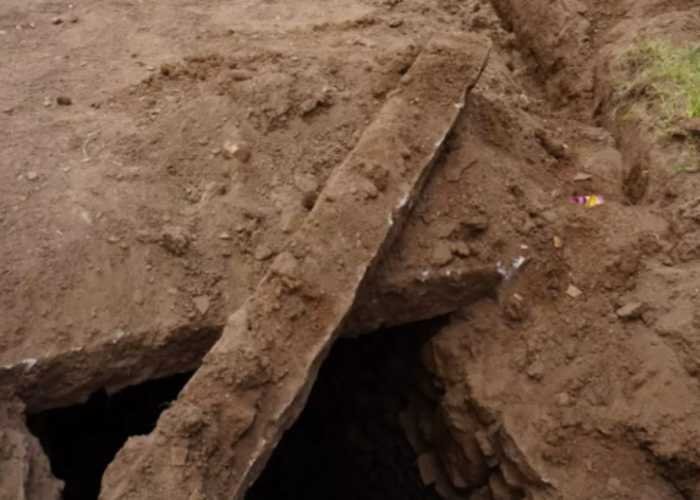
A preliminary examination found that the structure was not a tunnel but a rectangular chamber measuring approximately 1.2 metres by 1.8 metres and 2.2 metres in depth.
According to the ASI, the chamber is built of granite stone, with rough stone masonry forming an internal wall-like structure. The team also recovered a few red-coloured potsherds that appear to belong to the medieval period.
The ASI said the exact purpose and use of the chamber could not be established through the preliminary inspection and would require a detailed investigation.
“The ASI Hyderabad Circle will report the matter to the ASI Director General Yadubir Singh Rawat and, upon approval, a detailed investigation will be undertaken to ascertain the purpose and usage of the chamber and to determine whether similar chambers exist in the surrounding area,” the agency said.
The ASI has also directed the Artillery Centre at Golconda not to undertake further land-levelling work until the nature and significance of the discovery are established.
The agency noted that the Bala Hissar portion of Golconda Fort is located on a hillock and that its fortification encloses several smaller structures built for public use when the fort functioned as a residential settlement.
Golconda Fort is one of the largest and most prominent forts in the Deccan Plateau. Built on a hill rising about 120 metres, the complex contains defensive structures, gateways, bastions, mosques, gardens, residential quarters and royal buildings. Its three lines of fortifications and 87 bastions make it a major example of medieval military architecture and urban settlement.
 FOLLOW NOW