

Nagoya, October 4, 2026 (Yes Punjab News)
The buses will stop running, accreditation cards will soon become souvenirs, and athletes rushing through airports will once again replace the colourful chaos of the past two weeks.
The Aichi-Nagoya Asian Games have come to an end.
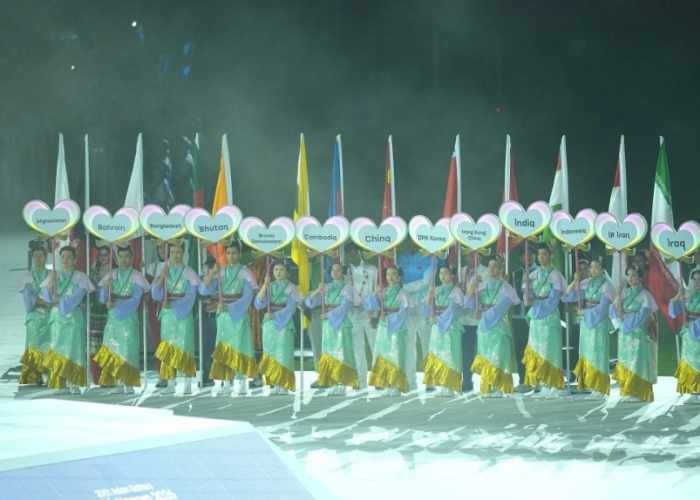
The closing ceremony, much like the opening, was a celebration of music, colour, dancing and flags, giving athletes perhaps their first real opportunity in days to pause, breathe and reflect on what they had achieved.
For India, the final night was filled with pride.
Shooter Neeru Dhanda led the Indian contingent as flagbearer, carrying the Tricolour into the stadium after an impressive campaign for the country. But her presence represented only one part of a much larger Indian story.
India finished fourth in the medal table with 85 medals — 21 gold, 27 silver and 37 bronze.
China topped the standings, followed by Japan and South Korea, while India’s overall tally reflected its growing presence across an increasingly diverse range of sports.
Some of the biggest celebrations, however, came from a sport that needs little introduction in India — cricket.
Cricket once again demonstrated that its presence at the Asian Games is no longer merely symbolic. India’s men’s and women’s teams both returned with gold medals.
The women’s team set the tone by handling the pressure of being among the leading contenders and delivering when it mattered. The men’s team followed with another gold, giving India a perfect two-gold finish in cricket.
For Indian cricket, the medals were more than additions to the overall tally. The Games offered another reminder of how far the sport has travelled beyond its traditional boundaries and of the significance of the Indian jersey even outside the world’s biggest cricket tournaments.
For many other Indian athletes, there was little glamour attached to the journey.
There were early morning starts, long journeys to venues and hours spent waiting for competition. Some travelled hundreds of kilometres for an opportunity to win a medal that might never make the front pages.
Yet they kept showing up.
That perhaps became the defining feature of India’s campaign.
Archery delivered five gold medals, while boxing added three and wrestling two. Hockey and kabaddi brought the familiar roar of team triumphs, with both the men’s and women’s teams winning gold.
Athletics produced its share of drama, as Indian runners and field athletes battled pressure and conditions to add valuable medals.
Golf also created history, with Pranavi Urs winning India’s first women’s individual Asian Games gold in the sport.
Shooting remained one of India’s strongest medal-producing disciplines, while weightlifting, badminton, squash, rowing, table tennis, sailing, wushu, kurash, MMA, soft tennis and several other sports contributed to the final tally.
The numbers tell one story. The athletes tell another.
Behind India’s 21 gold, 27 silver and 37 bronze medals are years of training distilled into a few minutes of competition. Some athletes arrived as favourites and delivered. Others arrived with little attention and left with their names known far beyond their own sporting circles.
Japan’s difficult fortnight
Away from the competition venues, Aichi-Nagoya was rarely free from criticism.
Transport emerged as a recurring frustration, as did the distances between venues. The absence of a traditional athletes’ village created additional challenges, while sparse crowds at some events did little to produce the atmosphere normally associated with the Asian Games.
For journalists, photographers and support staff, travelling between venues sometimes became an event in itself.
Japan, a country widely associated with precision and efficiency, consequently found itself under an unusually bright spotlight.
But the Games also revealed another side of the story.
Despite the organisational difficulties, competitions were completed. Athletes competed, medals were won and records were broken. Eventually, the closing ceremony arrived.
Perhaps that is the fairest way to assess a sporting event.
Not everything went according to plan. But the sport survived the imperfections.
And ultimately, that is what the athletes are likely to remember.
Soon, the venues will fall silent again.
The banners will come down. Temporary signs will disappear. Medal ceremonies will become photographs stored on athletes’ phones.
For India, the 85 medals will remain in the record books. But the memories will be much more personal.
A victory celebrated with teammates. A defeat followed by a hug. A coach wiping away tears.
A parent watching nervously from the stands. An athlete hearing the national anthem after achieving a lifelong dream.
And, on the final evening, a contingent walking together behind the Tricolour.
Aichi-Nagoya may not have been a perfect Asian Games. But sport rarely is.
It is messy, unpredictable and sometimes brutally unforgiving.
That is precisely why, after the criticism, long journeys, rain, empty seats, unexpected defeats and glorious victories, the Games still managed to leave behind what every sporting festival ultimately seeks — memories that outlive the closing ceremony.
 FOLLOW NOW