New York, August 18, 2026 (Yes Punjab News)
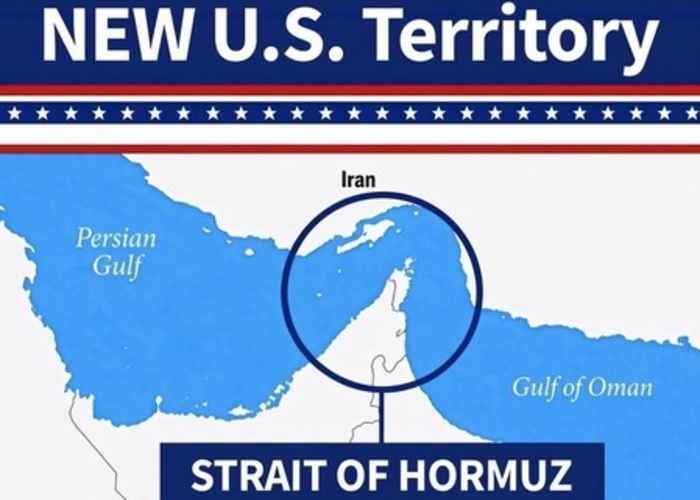
US President Donald Trump has renewed his claim over the Strait of Hormuz, posting a map on Truth Social that labelled the strategically vital waterway as “New US Territory”, even as tensions with Iran escalated following the collapse of a bilateral memorandum of understanding (MoU).
Trump said the Strait of Hormuz was “open and operating” and claimed that all sea mines had been removed or detonated. However, shipping activity through the waterway remained far below normal levels, according to agencies monitoring maritime traffic.
Trump also said the US naval blockade of Iranian ports “remains in full force and effect”, as his administration faces domestic pressure over rising prices linked to the disruption around the crucial energy route.
Maritime security concerns persisted on Tuesday. The United Kingdom Maritime Trade Operations (UKMTO) reported that a bulk carrier was struck by an unidentified projectile while transiting the Strait of Hormuz, causing damage to the vessel and casualties among its crew. The agency, which had reported a similar incident a day earlier, advised vessels to transit the area with caution.
Iran has rejected Trump’s claims over the waterway. Deputy Foreign Minister Kazem Gharibabadi described the proposal to seize the Strait as a “fanciful delusion” that could not be achieved through a social media post.
Iranian Parliament Speaker Mohammad Baqer Qalibaf also said the Strait would not reopen until Iran’s conditions were met, according to Tasnim news agency.
Trump on Monday also threatened Oman, a US ally, over its reported involvement in efforts to reopen the waterway. Iran has said it was close to finalising an arrangement with Oman under which each country would control shipping routes on its respective side of the Strait.
The Strait of Hormuz, which is about 167 km long, lies between Iran and Oman and provides a key passage for global energy shipments. The United Arab Emirates also borders the waterway. Any attempt by the US to exercise unilateral control would face significant diplomatic, legal and military challenges.
The latest escalation follows the collapse of the US-Iran MoU signed in June. The agreement provided a 60-day window for negotiations on Iran’s nuclear programme and envisaged the resumption of normal shipping, but the two sides did not agree to extend it when the deadline expired on Monday.
The situation deteriorated after attacks on vessels and subsequent US military action against Iran, including strikes and a blockade of Iranian ports. Iran has also attacked targets in the Gulf and elsewhere, further escalating regional tensions.
Trump said on Tuesday that there were no talks or discussions with Iran taking place or scheduled. Iranian Revolutionary Guard Corps spokesperson Brigadier General Hossein Mohebbi similarly told Tasnim that no negotiations were underway.
The deadlock has heightened concerns over further disruption in the Strait of Hormuz, through which a significant share of global energy supplies normally passes.
 FOLLOW NOW