

New Delhi, September 3, 2026 (Yes Punjab News)
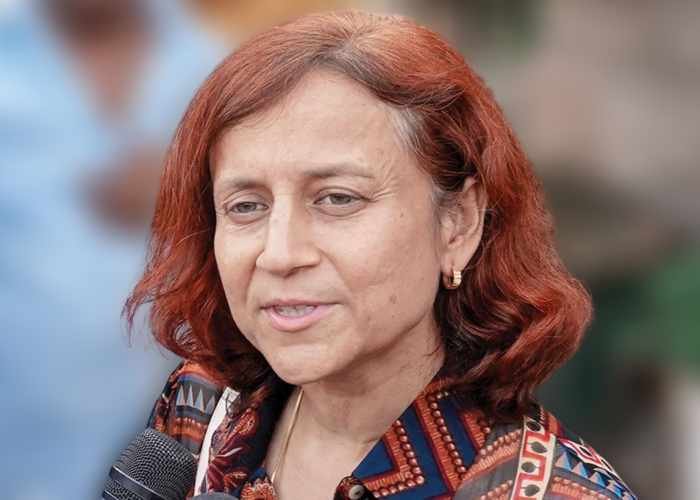
Gitanjali Angmo, wife of climate activist and educator Sonam Wangchuk, has criticised the use of the term “dimagi Naxal” for people who raise questions, calling it an insensitive way of describing those who engage in enquiry.
In an exclusive conversation with IANS, Angmo also spoke about what she described as a “slave mentality” in India’s approach to education, science and intellectual frameworks. She argued that India often continues to follow systems developed elsewhere without adequately examining its own intellectual traditions.
“Definitely, there is a slave mentality. Because all our frameworks, look at economic frameworks, educational frameworks, physics, mathematics, everything, whatever theorem names are there, when the Renaissance happened in the 16th and 17th centuries, when many European scientists, physicists and philosophers put forward different frameworks, India is following those same ones today,” she said.
Angmo also pointed to the historical engagement of Western thinkers with Indian philosophical texts.
“We know Oppenheimer read the Gita, Einstein read the Upanishads, and Plato and many Western philosophers and scientists read Indian texts and drew ideas from them. But many times, they presented them as their own theories, and we accepted that second-hand version. What they said after reading our texts, we accepted as the same hand-me-down,” she claimed.
On the phrase “dimagi Naxal”, Angmo said questioning has traditionally been an integral part of Indian philosophical thought and education.
“To me, calling someone a ‘dimagi Naxal’ is a very insensitive way to describe someone who asks questions. In our own tradition, enquiry has never been considered negative,” she said.
She cited examples from Indian scriptures, including Nachiketa’s questions to Yama and Arjuna’s questioning of Krishna in the Bhagavad Gita.
“Arjuna even disagrees with Krishna’s views at times. So, would we call Arjuna a ‘dimagi Naxal’? No,” Angmo said.
She stressed that questioning itself should not be viewed negatively and that the intent behind a question is important.
“Because enquiry was part of our education system. Asking questions was a good thing. Yes, intent is important. Some children genuinely ask questions out of curiosity, while others may do so for other purposes. Therefore, it’s not wrong to ask questions; we should consider the intent behind the question,” she told IANS.
Prime Minister Narendra Modi had earlier used the phrase “dimagi Naxal” during his Independence Day address from the Red Fort on August 15.
 FOLLOW NOW