New Delhi, August 20, 2026 (Yes Punjab News)
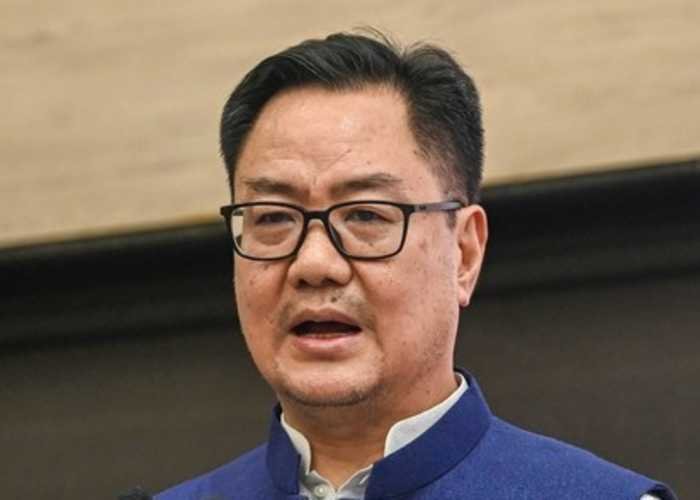
Union Parliamentary Affairs Minister Kiren Rijiju on Thursday said border development, infrastructure and connectivity have become a “top priority” under the Narendra Modi government, asserting that regions neglected in the past are now receiving focused attention.
Rijiju shared on X a video from his recent visit to the remote border areas of Maza, Galemo and Taksing in Arunachal Pradesh, where he reviewed infrastructure work and interacted with security personnel and local residents.
“Borders were neglected in the past but it’s top priority now,” Rijiju said, adding that he had visited the areas to accelerate infrastructure projects along the frontier.
His remarks came amid Opposition allegations that the Centre has concealed information about alleged Chinese incursions and failed to adequately protect Indian territory.
In an interview with IANS on Wednesday, Rijiju rejected such claims and said the situation in Arunachal Pradesh needed to be understood in the context of the absence of a formally demarcated India-China boundary in several areas.
He said the India-China border in Arunachal Pradesh has not been clearly delineated on the ground and that there are no border pillars marking the boundary at several locations.
“India and China share a very long border in Arunachal Pradesh that has not been formally delineated,” Rijiju said, adding that the issue was not new and dated back to the period when Tibet was a separate entity.
Rijiju acknowledged that concerns among villagers living in border areas were genuine but cautioned against spreading unverified videos and claims that could create confusion.
Infrastructure push along frontier
Rijiju attributed some of the concerns to the historically slow development of infrastructure on the Indian side of the border.
Targeting previous Congress-led governments, he cited former Defence Minister A.K. Antony’s reported statement in Parliament that the government had not pursued infrastructure construction along the frontier as a policy.
Rijiju said the approach changed after 2014, with the Modi government accelerating construction of roads and connectivity projects in strategically important areas.
He cited the construction of a road to Maza and said connectivity to Taksing had also been developed. According to him, the road to Taksing was completed in 2019.
Rijiju said China had developed infrastructure in areas where India had historically lacked comparable connectivity, and that India was now strengthening its own infrastructure and security presence.
He rejected the claim that China had occupied Indian villages, saying some disputed stretches remain affected by the absence of a clearly demarcated boundary.
He also said Indian Army and Indo-Tibetan Border Police (ITBP) patrolling had been strengthened in sensitive areas.
Concerns over Chinese activity
Rijiju referred to an area beyond Longju where, according to him, Chinese forces have constructed structures resembling a village. He said the area had come under Chinese control in 1959 and that China further consolidated its position there in 1962.
He acknowledged that Chinese military activity along the ridgeline had increased, contributing to concerns among residents.
“We must take their apprehensions seriously,” he said.
At the same time, Rijiju accused the Congress of using misleading material to advance a political narrative on the border issue.
He said circulation of a purportedly fake video allegedly originating from Bangladesh was inappropriate and argued that such content could undermine the morale of the armed forces.
Rijiju maintained that strengthening infrastructure and connectivity in border areas was essential for both national security and the welfare of communities living in remote frontier regions.
 FOLLOW NOW