
United Nations, October 8, 2026 (Yes Punjab News)
India has accused Pakistan of losing control of the terror networks it allegedly created and sheltered, saying the groups have now turned their violence back on the country and calling for international action against states that sponsor terrorism.
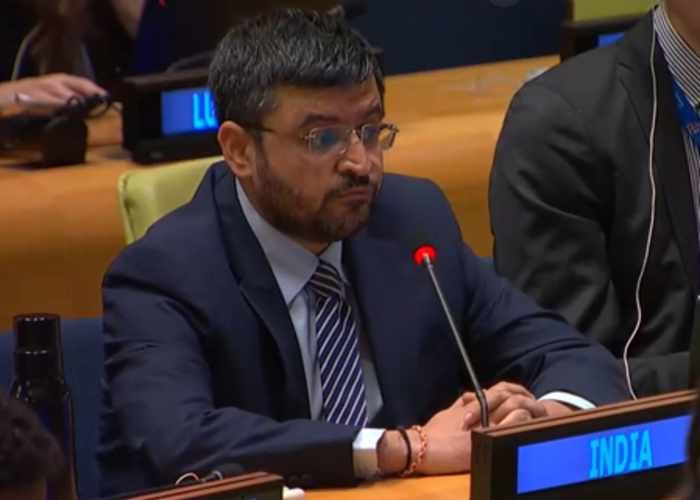
Speaking in the UN General Assembly’s Sixth Committee, which deals with legal matters, First Secretary at India’s UN mission Raghoo Puri said Pakistan had sought to portray itself as both a frontline state against terrorism and a victim of terror while concealing its alleged role in supporting militant groups.
“Pakistan has presented itself as a frontline state in combating terrorism and as a victim, while masking the fact that the Frankenstein’s monster the Pakistani state has created and lost control over have moved from wreaking havoc in neighbouring countries to doing the same in Pakistan,” Puri said.
He cited recent remarks by Pakistan Punjab Chief Minister Maryam Nawaz, who said the threat faced by her province came more from neighbouring provinces than neighbouring countries. Puri also referred to an interview given by her father and former Pakistan Prime Minister Nawaz Sharif in 2018, in which he acknowledged the presence of militant organisations and questioned whether Pakistan should allow them to cross the border and attack Mumbai.
Responding to Pakistan’s criticism of India, Puri also rejected Islamabad’s claims of victory during Operation Sindoor, describing them as part of a campaign of misinformation and disinformation.
“If bombed-out airfields and cratered runways look like victory to Pakistan, they are, of course, welcome to enjoy it,” he said.
Puri said Pakistan’s repeated responses relied on what he described as a “circular economy of words and narratives”, adding that greater efforts against terrorism instead of narrative-building would benefit the world.
He also rejected Pakistan’s allegations concerning minorities in India, pointing to the Pahalgam terror attack and alleging that the victims had been targeted on the basis of their religion.
The Indian diplomat further raised the issue of Jaish-e-Mohammed chief Masood Azhar, questioning Pakistan’s claim that it was seeking to apprehend the UN-listed terrorist. He referred to reports that Pakistan had increased the reward for information leading to Azhar’s capture from Rs 50 lakh to Rs 70 lakh.
Puri said Azhar had publicly spoken about the impact of Operation Sindoor on one of his camps in Bahawalpur, arguing that Pakistani authorities should therefore know his whereabouts.
He also invoked the 9/11 attacks and the 26/11 Mumbai terror attacks, saying the international community had not forgotten where al-Qaeda leader Osama bin Laden was found or the deaths caused by the 2008 Mumbai attacks.
“The world has not forgotten 26/11. The world has not forgotten Pahalgam,” Puri said.
He stressed that when terrorist organisations are permitted to operate with state support and perpetrators are provided safe havens, international commitments against terrorism lose their meaning and victims are denied justice.
Puri also referred to Pakistan’s alleged financial support for terrorism ahead of the Financial Action Task Force (FATF) plenary meeting scheduled to be held in Paris from October 26 to 30.
 FOLLOW NOW