
Beijing, August 13, 2026 (Yes Punjab News)
China’s ruling Communist Party is using Buddhism to reinforce political control and promote loyalty to the state despite its officially atheist ideology, according to an analysis published in the Journal of Democracy.
Khedroop Thondup, nephew of the 14th Dalai Lama, wrote that the Chinese Communist Party (CCP), whose ideological foundation is Marxism, has historically regarded religion as superstition and a remnant of feudal society that could obstruct socialist modernisation.
Religious institutions came under severe repression, particularly during the Cultural Revolution, when temples were destroyed, monks defrocked and religious scriptures burned. The CCP later recognised that religion could not simply be eliminated through government decrees.
“China is officially atheist. The Chinese Communist Party (CCP) has long declared religion to be superstition, a relic of feudalism, and a distraction from socialist modernisation,” Thondup wrote.
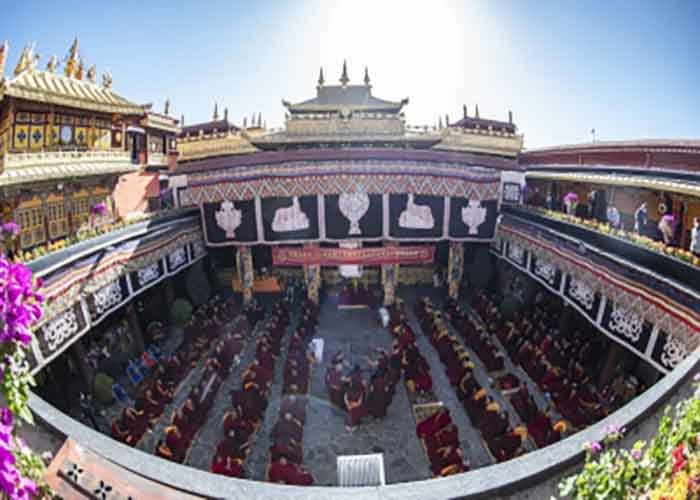
He said the restoration and promotion of Buddhist temples in cities including Beijing, Shanghai and Chengdu reflected political calculations rather than a religious revival.
According to the analysis, China officially recognises five religions — Buddhism, Taoism, Islam, Catholicism and Protestantism. Buddhism, however, occupies a distinctive position because it is viewed as indigenous to China, culturally Chinese and largely politically compliant.
Thondup argued that this makes Buddhism particularly useful to the CCP as a form of “civil religion” that can reinforce state authority without directly challenging it.
An estimated 100 million people in China identify as Buddhist, the report said. However, Buddhist institutions and practices remain subject to extensive state oversight. Monasteries are required to register with the authorities, while abbots may be selected partly on the basis of their political reliability.
The analysis further alleged that Buddhist teachings are being interpreted to emphasise obedience, social harmony and patriotism. Temples have also increasingly been developed as tourist attractions, while religious institutions and personnel are incorporated into state structures.
Thondup said Beijing’s efforts to regulate reincarnation, religious devotion and ritual demonstrate the extent to which the CCP seeks to control religious life.
He concluded that China’s approach reflects a broader contradiction: an officially atheist government that nevertheless recognises the political influence of faith and seeks to manage rather than eliminate it.
 FOLLOW NOW