

India has warned Pakistan that threats involving nuclear weapons will not deter New Delhi from responding to terrorism, asserting that any terrorist attack against the country will invite a fitting response.
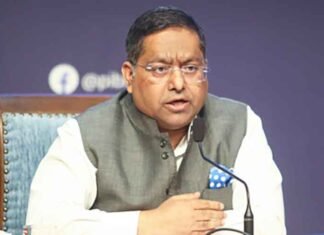
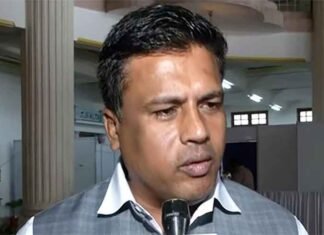
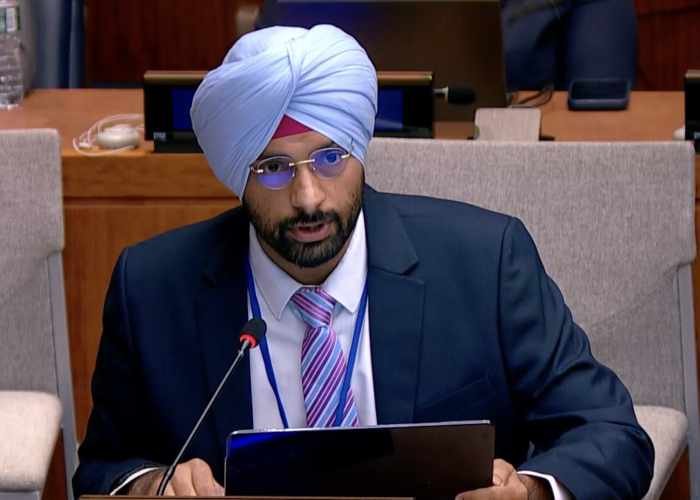
“India will not bow to nuclear blackmail,” Anmol Sher Bedi, senior adviser at India’s Permanent Mission to the UN Conference on Disarmament in Geneva, said on Friday during a meeting of the UN General Assembly’s First Committee, which deals with disarmament issues.
Responding to Pakistan’s Permanent Representative to the UN in Geneva, Tahir Andrabi, Bedi said India would make no distinction between those who sponsor terrorism and those who mastermind attacks.
He cited Operation Sindoor, launched last year against terrorist bases in Pakistan following the Pahalgam attack, in which Pakistan-based terrorists killed 26 civilians.
“India acted in self-defence,” Bedi said, describing the operation as measured, targeted and designed to avoid escalation.
He cautioned against treating nuclear weapons as routine instruments of state policy, arguing that using the threat of nuclear escalation to shield terrorist activity increases regional risks rather than promoting restraint.
Bedi also reiterated that India’s nuclear capabilities are defensive in nature and are shaped by its security environment. He contrasted India’s declared no-first-use policy with what he described as Pakistan’s reliance on the nuclear threat to limit the consequences of terrorism.
Turning to nuclear proliferation, Bedi raised concerns over the network associated with Abdul Qadeer Khan, who led Pakistan’s nuclear programme and whose network was linked to the transfer of nuclear technology to other countries. He urged states and suppliers to exercise caution when considering nuclear cooperation or transfers of advanced military capabilities to Pakistan.
“On proliferation, India refers to the history of the AQ Khan network, which contributed to the Security Council Resolution 1540 almost two decades back,” he said.
Bedi added that vigilance was necessary for the security of all countries, not merely in response to India’s concerns. UN Security Council Resolution 1540, adopted in 2004, requires states to prevent the proliferation of weapons of mass destruction and stop non-state actors from acquiring them.
He also accused Pakistan of repeatedly fuelling regional crises through terrorism, describing a pattern of provocation, denial of responsibility and subsequent appeals for restraint after India responds.
Bedi attributed this cycle to Pakistan’s military-dominated power structure, arguing that decision-makers who are not directly accountable to the electorate face limited political costs for their actions.
On Kashmir, he rejected Andrabi’s remarks, reiterating India’s position that Jammu and Kashmir is an integral and inalienable part of the country. He called on Pakistan to vacate the territories India describes as illegally occupied.
Bedi also said India had placed the Indus Waters Treaty in abeyance because, in New Delhi’s view, Pakistan had undermined the trust and cooperation on which the agreement was based.
 FOLLOW NOW