
Chicago, October 5, 2026 (Yes Punjab News)
More than a decade of research through archival collections in India, Britain and the United States has led Indian-American scholar Sridhar D. Damle to a portrait of Vinayak Damodar Savarkar that he says differs substantially from the political image surrounding one of modern India’s most contested figures.
Damle, a scholar of the Rashtriya Swayamsevak Sangh (RSS), is completing a book on Savarkar after examining tens of thousands of pages of British intelligence records, US diplomatic papers, Indian police files, court material and other archival documents.
In an exclusive interview with IANS, Damle said his research, which began in 2010, has so far yielded more than 30,000 pages documenting how governments, diplomats, police officials and others viewed Savarkar.
He described Savarkar as a revolutionary, social reformer and political thinker whose ideas, in his assessment, cannot be understood solely through later debates over Hindutva, Hindu nationalism, Partition and the assassination of Mahatma Gandhi.
Among the material Damle considers significant is a document from Savarkar’s London period in 1906. Damle said he found a copy of the document in British-confiscated material preserved on microfilm at the University of Chicago.
According to Damle, the document envisaged an independent India based on democracy, equality before law, merit in public employment and universal voting rights, while leaving the question of whether the country should have a president or monarch to a future constituent assembly.
Damle also disputes what he considers a simplistic interpretation of Savarkar’s petitions to British authorities during his imprisonment. He argues that the petitions should be examined in the context of the colonial prison system and the legal categories under which Savarkar was held.
His research also examines the Gandhi assassination case. Savarkar was tried in the case and acquitted by the trial court. Damle said his archival collection includes the original police investigation material as well as a US diplomatic account that, according to him, recorded an early assessment by the government’s chief prosecutor that there was insufficient evidence against Savarkar.
Damle said the material raised questions about the attempt to establish Savarkar’s personal involvement in the assassination, while stressing that political association alone could not establish responsibility.
The scholar also draws on a personal encounter to support his assessment of Savarkar’s democratic outlook. Damle said he met Savarkar on January 14, 1960, when he was a college student, and that the two spoke for about an hour.
According to Damle, he questioned Savarkar about his criticism of the dismissal of Kerala’s elected Communist government. Damle recalled Savarkar responding that democracy required governments to be changed through elections rather than executive intervention.
Damle further portrays Savarkar as a rationalist and agnostic who regarded religions and holy books as products of human beings and believed science and human welfare should ultimately guide society.
At the same time, Damle acknowledges Savarkar’s advocacy of Hindutva and Hindu organisation. He said his research indicates that Savarkar supported equal citizenship and religious freedom for minorities while arguing for a united Indian nation.
His research also covers Savarkar’s opposition to Partition, his views on national security and China, and his interest in developments in Tibet and the strategic importance of buffer states.
Damle said his archival work has uncovered material linking Savarkar to wider international anti-colonial networks as well. Among the documents he found in the Irish-American weekly Gaelic American were writings from Savarkar’s London years, including an appeal to Indian Muslims to participate in the freedom struggle and material concerning the Khalsa.
The research has also extended to Savarkar’s social reform efforts, including his opposition to untouchability and caste barriers, support for inter-caste marriage and reconversion, and attempts to introduce modern terminology into Marathi.
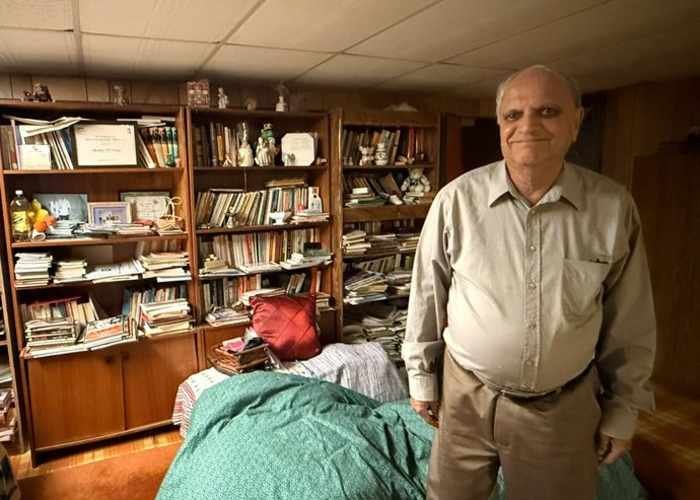
Damle, 84, said he is still seeking access to additional records, including around 850 pages of Mumbai CID material relating to Savarkar. He said bureaucratic hurdles had prevented him from obtaining some documents he believes should be available to researchers.
His longer-term objective, he said, is to make the documentation he has collected available online for students, journalists and other researchers.
Damle is an independent scholar based in the United States and is known for his work on the RSS. With Walter K. Andersen, he co-authored The Brotherhood in Saffron: The Rashtriya Swayamsevak Sangh and Hindu Revivalism and later The RSS: A View to the Inside.
Savarkar, born in 1883, was an Indian revolutionary, writer and political leader who spent years imprisoned by the British, including at the Cellular Jail in the Andaman Islands. He later became president of the Hindu Mahasabha and a principal exponent of Hindutva. He was tried in connection with the 1948 assassination of Mahatma Gandhi but was acquitted.
 FOLLOW NOW