New Delhi, September 19, 2026 (Yes Punjab News)
India’s counter-terrorism approach is increasingly focused on identifying and disrupting terror and radicalisation modules before they can execute attacks, with the government’s National Counter-Terrorism Policy and Strategy, PRAHAAR, providing a formal framework for intelligence-led prevention.
The Ministry of Home Affairs unveiled PRAHAAR on February 23, 2026, describing it as India’s first comprehensive national counter-terrorism policy and strategy. The seven-pillar framework emphasises prevention, swift and proportionate response, whole-of-government coordination, rule-of-law and human-rights-based processes, countering radicalisation, international cooperation, and recovery and resilience.
According to senior security officials cited in the source material, the operational emphasis is now on acting on actionable intelligence rather than waiting for a terror attack to take place.
“The focus is on preventing terror attacks and ensuring that terror modules do not grow to such an extent that bringing them under control becomes a Herculean task,” an official said.
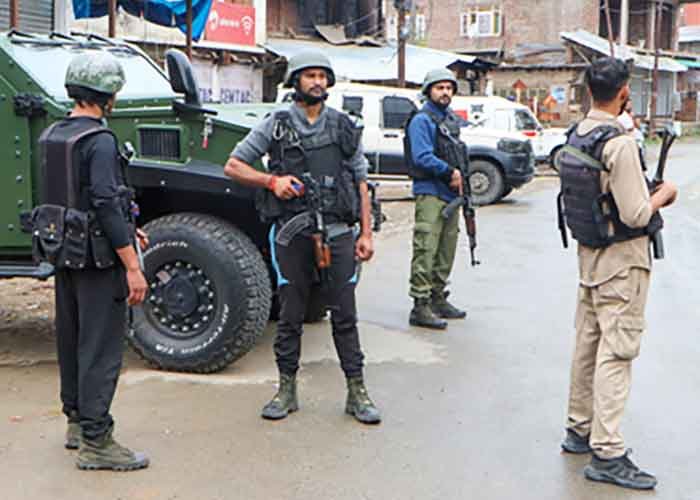
An Intelligence Bureau official said the approach is also being applied in Jammu and Kashmir, where security agencies have been working to disrupt terror networks, overground-worker networks and infiltration attempts.
“In the past couple of months, security agencies in Jammu and Kashmir have neutralised terrorists, busted multiple modules and ensured that the overground worker network remains grounded,” the official said, adding that the objective is to make it more difficult for terror networks to plan and execute attacks.
The PRAHAAR framework formally calls for intelligence-led prevention and greater coordination among intelligence agencies, state police and central agencies. The government has also said the policy provides for real-time intelligence sharing through the Multi Agency Centre and coordinated responses involving state agencies and specialised central forces.
Officials cited in the source said radicalisation remains another major challenge, with modules being detected in several states. They said security agencies have moved to disrupt such networks at an early stage when actionable intelligence becomes available.
The source specifically cited the busting of a pan-India radicalisation module in Andhra Pradesh as an example, as well as action in Gujarat against a self-styled module linked to the ideology of Jaish-e-Mohammad.
“If intelligence is actionable, the agencies move immediately to disrupt the module and prevent it from developing further,” officials said.
The strategy also covers threats originating from across India’s neighbourhood. Officials said attempts by Harkat-ul-Jihadi Islami (HuJI) and Jamaat-ul Mujahideen Bangladesh (JMB) to establish networks targeting West Bengal and the northeastern states have been thwarted.
The government’s PRAHAAR document states that India’s counter-terrorism strategy is based on prevention while maintaining a zero-tolerance approach towards terrorism. It also explicitly states that India does not link terrorism to any specific religion, ethnicity, nationality or civilisation.
The policy, according to the Ministry of Home Affairs, seeks to consolidate internal capacities and create a coordinated national response to terrorism and radicalisation rather than relying solely on post-incident action.
 FOLLOW NOW