
New Delhi, September 16, 2026 (Yes Punjab News)
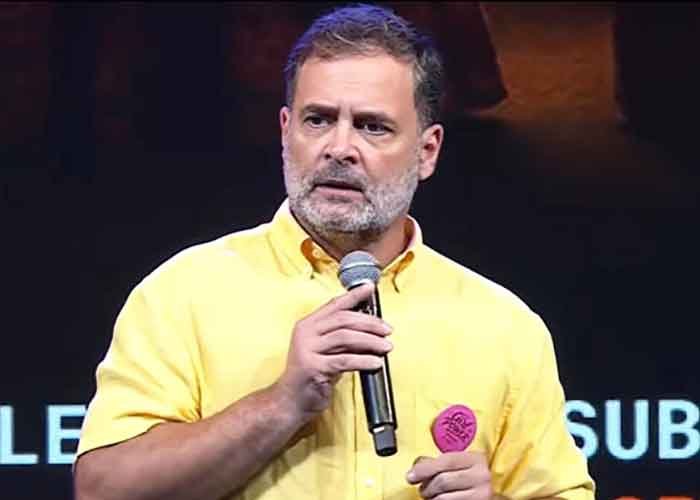
NDA leaders on Wednesday rejected Congress leader and Lok Sabha Leader of Opposition Rahul Gandhi’s allegation that the Centre’s revised UPI Merchant Discount Rate (MDR) framework was introduced under pressure from the United States, defending the move and arguing that it would not impose charges on ordinary users.
Union Minister Ramdas Athawale said the revised framework was fair and would not create difficulties for small vendors and businesses.
“I feel that the decision taken by the government regarding UPI transactions up to Rs 2,000 is fair. For transactions up to Rs 2,000, small vendors and businesses face no issues. However, if their business transactions exceed Rs 2,000, charging a nominal 0.4 per cent fee is not a huge burden. For instance, on transactions up to Rs 75,000, they only have to pay around Rs 300,” Athawale said.
He also rejected Gandhi’s allegation of US pressure, saying the United States had no connection with the decision.
BJP MP Gulam Ali Khatana also defended the framework and accused the Congress of creating apprehension among people over UPI charges.
“Congress should look within itself and see what it did during its time. The Congress wants to create fear in society. There is no burden on the poor regarding UPI charges. However, when you use a facility and make bulk transactions, institutions should receive some consideration,” Khatana said.
BJP national spokesperson Guru Prakash also criticised Gandhi’s reference to the United States, accusing him of repeatedly attributing government decisions to American pressure.
“Rahul Gandhi ji has developed a Trump phobia, an America phobia. Every decision that is made is under pressure from America,” Guru Prakash said, while referring to past statements by Congress leaders about alleged US influence.
He also cited an earlier statement attributed to Congress leader P. Chidambaram while questioning the Congress’ criticism of the UPI framework.
Guru Prakash said India had developed a robust digital payments ecosystem and questioned the basis of the figures cited by Gandhi.
“Rahul Gandhi has been pushing his own agenda for the last two days, but there was no basis for it. He does not make any concrete or substantial points,” he said.
JD(U) national spokesperson Rajiv Ranjan told IANS that ordinary consumers should not be overly concerned, arguing that the revised MDR was a minor cost within the merchant ecosystem.
“Ordinary consumers do not need to worry too much. Generally speaking, we can say that this is a very minor increase, and even that cost will have to be borne by the merchants,” he said.
The Finance Ministry earlier clarified that the revised MDR framework was not the result of foreign influence and said India’s digital payment policy decisions are made independently. The ministry said UPI, launched in 2016, had grown into the world’s largest real-time interoperable payment system.
Under the revised framework, announced by the National Payments Corporation of India (NPCI), a 0.4 per cent MDR will apply to specified person-to-merchant (P2M) UPI transactions above Rs 2,000, with the charge capped at Rs 300 for transactions of Rs 75,000 and above. Person-to-person transactions will remain free.
The Finance Ministry has also clarified that customers will not pay the MDR directly. Payments to merchants up to Rs 2,000 and transactions covered under the zero-MDR framework for small merchants will remain free, with approximately 96 per cent of P2M transactions expected to remain unaffected.
The revised framework comes into effect from October 15, 2026.
Gandhi had on Tuesday criticised the Centre over the revised framework. In a post on X, he said the government had “quietly opened the door to imposing fees on UPI” and alleged that US payment companies had long opposed India’s zero-MDR policy.
The Congress leader also alleged that the revised policy was moving in a direction sought by American payment companies. Those remarks were followed by the government’s clarification that India’s digital payment decisions were being taken independently.
The debate centres on MDR, a charge within the merchant payment ecosystem rather than a direct fee imposed on UPI users. The government has said the framework is intended to support the long-term sustainability of the UPI ecosystem while protecting individuals and small merchants from additional payment costs.
 FOLLOW NOW