


Vadodara, September 8, 2026 (Yes Punjab News)
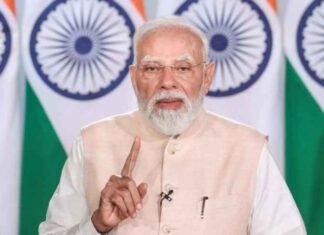
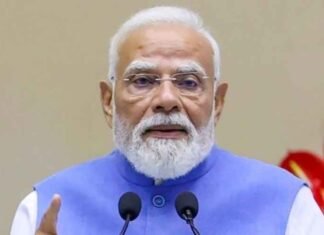
Prime Minister Narendra Modi on Tuesday took a swipe at his political opponents while highlighting the wider economic benefits of the Dedicated Freight Corridor, using the phrase “naraz fufa ji” (annoyed uncle) to dismiss a hypothetical objection that faster freight trains could hurt truck operators.
While describing the operation of a double-stack container freight train between JNPT in Mumbai and Vadodara, PM Modi said a single such train could carry cargo equivalent to more than 250 trucks.
“The annoyed uncle will shout: what will happen to the truck operators? Where will the trucks go? What will happen to those who bought trucks?” PM Modi said, referring to critics as “naraz fufa ji”.
He said the freight corridor was not intended to eliminate road transport but to expand India’s overall logistics capacity by enabling large volumes of goods to move faster, while trucks could continue serving other transportation needs.
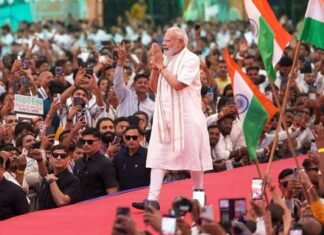
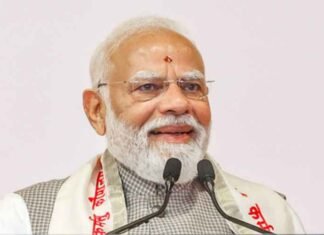
The remarks came as PM Modi dedicated the final key sections of the Western Dedicated Freight Corridor in Vadodara, completing the Dedicated Freight Corridor network.
The three sections cover 326 route kilometres and were developed at a cost of more than Rs 20,700 crore. The completed network is aimed at separating freight and passenger traffic, increasing cargo capacity and reducing transit times.
In another political reference, PM Modi contrasted what he described as misleading claims with his government’s presentation of development figures.
“There are people at every crossroads who can mislead you with jooth ki goonj (echo of lies). But India’s youth move with the sach ki hunkar (call of truth) and they move for the call of truth,” he asserted.
He made the remarks while discussing India’s expansion in renewable energy and emerging technologies.
“The country is focusing on solar, wind, hydro and nuclear energy because future industries such as semiconductor manufacturing, data centres and artificial intelligence would require large amounts of reliable electricity,” PM Modi said.
He said India had developed more than 200 GW of solar module manufacturing capacity and referred to the PM Surya Ghar Muft Bijli Yojana, stating that 55 lakh families across the country had installed rooftop solar systems, including 11 lakh families in Gujarat.
PM Modi linked the growth of renewable energy with employment opportunities, saying the expansion was creating jobs in production, installation and servicing while bringing new vendors into the market.
He also said India was working to secure supplies of uranium, critical minerals and rare-earth minerals through international agreements, describing these efforts as preparations for the future of the country’s youth.
Turning to skills and artificial intelligence, the Prime Minister said the changing economy required young people to acquire skills alongside formal degrees.
He said the government was moving towards providing free online coaching for students preparing for competitive examinations, with classes from what he described as “the country’s best teachers”.
PM Modi also announced that a major government campaign would be launched to prepare young people for artificial intelligence.
“AI skills would not be limited to the IT sector and could be applied in agriculture, healthcare, manufacturing and robotics,” he said.
“India’s youth must become proficient in AI,” he added, saying young people could use the technology to develop agricultural solutions, healthcare applications, manufacturing improvements and robotics start-ups.
The Vadodara programme included projects worth more than Rs 35,000 crore across railways, highways, housing, water supply, urban development and renewable energy.
Three sections of the Western Dedicated Freight Corridor were dedicated to the nation, while new rail services were flagged off and foundation stones were laid for additional railway and highway projects.
 FOLLOW NOW