
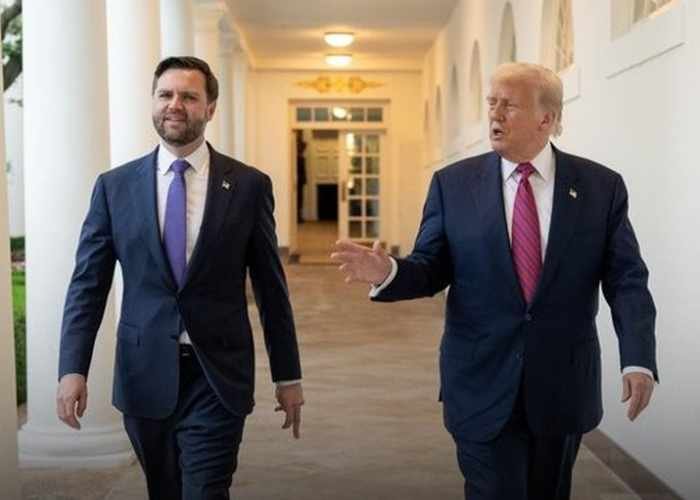
US President Donald Trump honoured Microsoft CEO Satya Nadella for his contribution to American technological leadership even as Vice President JD Vance accused the company of misusing skilled-worker immigration programmes and announced restrictions on its access to employment-based permanent residency processing.
The contrasting developments highlighted the Trump administration’s attempt to promote technological innovation while tightening scrutiny of employers hiring foreign professionals.
During a press conference on visa fraud, a reporter questioned Vance about the apparent contradiction between Trump recognising Microsoft’s leadership and the administration targeting its immigration practices.
Vance defended the distinction, describing Microsoft as a major American company while insisting that it must prioritise domestic workers.
“Microsoft is a great American company and we have a great relationship with them,” Vance said. He added that the administration would continue supporting the company but would deny it the ability to apply for permanent residency until it demonstrated a commitment to putting American workers first.
Hours later, Trump praised Nadella at the New Golden Age Summit, where six prominent technology leaders received the National Medal of Science or the National Medal of Technology and Innovation.
Trump credited Nadella with transforming Microsoft over more than three decades, strengthening its cloud computing business and helping position the company at the forefront of technological development.
Nadella, who was born in Hyderabad and became Microsoft’s CEO in 2014, thanked Trump for the recognition in a post on X. He said he was honoured to stand alongside other leaders in American innovation and looked forward to advancing technology and economic prosperity.
The recognition came amid a significant immigration enforcement announcement involving Microsoft and several major technology services companies.
At the earlier press conference, Vance accused Microsoft of laying off 6,000 American workers while benefiting from 6,300 H-1B visa approvals and nearly 3,000 green cards. He argued that companies were using foreign workers to undercut American wages. However, the information presented did not establish that individual H-1B employees directly replaced workers laid off by Microsoft.
Labour Secretary Keith Sonderling announced that the Department of Labour was suspending Microsoft and Adobe from the Permanent Labour Certification programme amid ongoing federal investigations. He also named six major IT services companies — Cognizant, Infosys, Tata, Wipro, HCL and Capgemini — as subject to suspensions.
“We will not accept any new or process any pending permanent labor certification applications involving these companies,” Sonderling said.
The PERM programme is an important step in many employment-based green card applications. The announced restrictions affect new and pending labour certification applications involving the named employers but do not, by themselves, cancel existing H-1B visas or revoke permanent residency already granted.
For Indian technology professionals, the announcement could create additional uncertainty around employer-sponsored routes to permanent residency, particularly given the substantial US operations of several companies named by the administration.
Vance said the government wanted technology companies to thrive and invest in the United States but maintained that American workers should receive priority. He distinguished between highly specialised international talent and what he described as routine hiring practices that could disadvantage domestic employees.
He cited entrepreneur Elon Musk and AMD CEO Lisa Su as examples of exceptional talent the country should welcome. Both were among the technology leaders recognised by Trump later in the day.
Asked how officials could identify future innovators whose achievements had yet to emerge, Vance said the administration would assess whether applicants possessed specialised abilities unavailable among American workers.
The policy challenge extends beyond the corporate sector. Administration officials also announced investigations into J-1 visa use at nine prominent universities, including Harvard, Yale, Stanford, MIT and Caltech, alleging that some institutions’ practices disadvantaged American workers. Those allegations remain subject to investigation.
Meanwhile, Trump used the summit to highlight the administration’s technological ambitions, including a target of developing a quantum computer for scientific discovery by 2028, alongside the Genesis Mission and the White House Accord on Superintelligence.
These initiatives depend on advanced research and specialised scientific and engineering talent, raising questions about how the administration will balance tighter employment-based immigration controls with its ambitions for technological leadership.
Nadella’s recognition and the restrictions announced against Microsoft illustrate the administration’s stated distinction between celebrating established technological achievements and scrutinising employers’ hiring practices.
For Indian professionals, the developments carry particular significance. Indian nationals have long represented a substantial share of the skilled foreign workforce in the United States, and the H-1B programme and employment-based green card process have been important pathways for technology workers building long-term careers there.
The administration’s challenge will be to enforce its commitment to American workers while ensuring that restrictions do not undermine its broader objective of keeping the United States at the forefront of global innovation.
 FOLLOW NOW