
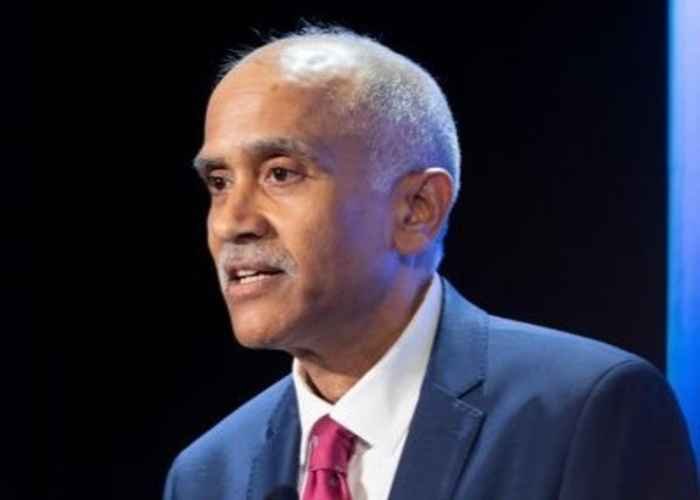
Hindi continues to retain its non-official language status at the United Nations, with India voluntarily funding initiatives to make UN news and information accessible to Hindi-speaking audiences worldwide, India’s Permanent Representative to the UN, P. Harish, has said.
Speaking at an event marking Hindi Divas at the UN on Thursday, Harish said the language’s inclusion in the Department of Global Communications’ (DGC) news and social media outreach had helped sustain its presence within the organisation’s multilingual communication efforts.
“In the recently adopted multilingualism resolution, Hindi has continued to retain a non-official language status on account of DGC’s transmission of news and social media in this language,” he said.
“India has voluntarily supported the Hindi at UN project, which makes UN news and information available to Hindi-speaking audiences worldwide,” Harish added.
The multilingualism resolution, co-sponsored by Andorra and adopted by the UN General Assembly last month, recognises the cultural, political and diplomatic significance of non-official languages in promoting representation and effective participation in the organisation’s work. It also reaffirms that representatives may deliver statements in non-official languages.
Harish reiterated India’s commitment to multilingualism at the United Nations, noting that the country had consistently supported resolutions aimed at strengthening linguistic diversity.
Quoting Union Home Minister Amit Shah, he said language was most meaningful when it connected people and cultures rather than divided them.
Harish described Hindi as the world’s third-largest spoken language and highlighted its growing international reach through the Indian diaspora, literature, cinema and digital platforms.
He said these channels had helped introduce India’s ideas, stories and cultural heritage to audiences across the world.
Joan Forner Rovira, Andorra’s Permanent Representative to the UN, welcomed the emphasis on linguistic diversity, linking language to international cooperation and human rights.
“Article 1 of the Charter of the United Nations calls upon us to promote international cooperation and respect for human rights and fundamental freedoms,” he said, adding that language was essential to achieving that vision.
“Within the United Nations, language is one of our most important tools of diplomacy,” Rovira said.
BJP MP C. P. Joshi also highlighted Hindi’s growing international presence, saying its influence extended beyond India’s borders.
He said the UN Department of Global Communications and India had signed a memorandum of understanding in 2018 to disseminate UN news in Hindi through voluntary Indian contributions. The agreement was renewed last year for another five years, he added.
Joshi emphasised that India’s linguistic diversity was an integral part of its cultural heritage.
“India is a multilingual and multicultural civilisation; all languages and dialects constitute our collective heritage,” he said, describing Hindi as an important part of the country’s wider linguistic tradition.
Amit Shah has also encouraged people to learn an additional Indian language, linking the initiative to the spirit of Ek Bharat Shreshtha Bharat — a vision of a united and culturally connected India.
Hindi’s continued use in UN communications reflects efforts to expand access to the organisation’s information in multiple languages. However, Hindi remains a non-official language of the United Nations, rather than one of its six official languages.
 FOLLOW NOW