
New Delhi, September 11, 2026 (Yes Punjab News)
A Delhi court has rejected the anticipatory bail plea of advocate Shubham Tyagi in the Satya Niketan building collapse case, observing that his claim of being merely an investor in a paying-guest (PG) business was prima facie contradicted by a separate rent agreement showing him as a co-lessee of two floors of the building.
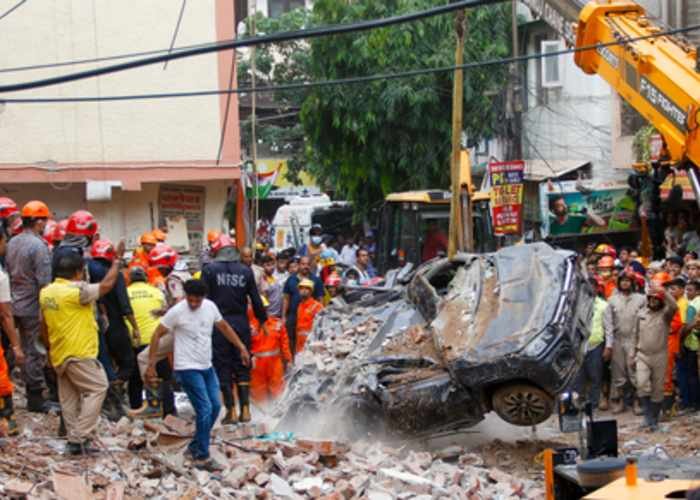
Additional Sessions Judge Saurabh Partap Singh Laler of the Patiala House Court dismissed Tyagi’s application under Section 482 of the Bharatiya Nagarik Suraksha Sanhita (BNSS), noting that seven people, including five students and two labourers, were killed when Building No. 14 at Satya Niketan Market in Moti Bagh-II collapsed.
The court said a rent agreement allegedly not disclosed in Tyagi’s bail application showed that he had taken the second and third floors of the building on rent specifically to operate a boys’ PG.
It observed that a person who rents an old multi-storeyed building for commercial accommodation of students and continues operating the facility while structural work is underway, despite occupants raising safety concerns, could not at the anticipatory bail stage be treated like an ordinary residential tenant with no responsibility to respond to apparent dangers.
The court, however, clarified that it was not making any final determination on whether the charge under Section 105 of the Bharatiya Nyaya Sanhita (BNS), relating to culpable homicide not amounting to murder, would ultimately be established against Tyagi.
The FIR was registered at South Campus Police Station on September 6 under Sections 105, 290 and 125(a) of the BNS. Initially registered against unidentified persons, the investigation subsequently led to the arrest of building owners Urmila Gupta, Hari Ram Gupta and Mahesh Gupta alias Sanjay, contractor Sanoj and PG operator Sudhanshu Lovenish Kumar.
Tyagi had told the court that he was an advocate practising at Patiala House Courts, had no criminal antecedents and was merely an investor in the PG business operated by his friend Lovenish Kumar.
He claimed that he was neither the owner of the building nor had any control over its structure or decision-making. He also argued that the rent agreement relied upon by him was in Lovenish Kumar’s name and that the lease had expired on August 30.
The prosecution opposed the plea, alleging that Tyagi was not merely an investor but a co-lessee and business partner of Lovenish Kumar. According to the prosecution, the two jointly operated PG accommodations under the name “Hostel Daze” at multiple buildings in Satya Niketan.
During the hearing, investigators produced another rent agreement dated September 6, 2025, executed between building owner Urmila Gupta and Tyagi for the second and third floors of Building No. 14.
The court noted that both agreements were executed on the same day and contained substantially similar terms, besides being attested by the same notary. Tyagi had signed Kumar’s agreement as a witness, while Kumar had signed Tyagi’s agreement as a witness.
“These contemporaneous documents,” the court observed, prima facie indicated that the two were jointly involved in taking the premises on rent and operating it as a PG, rather than Tyagi merely making a friendly investment.
The court further said the alleged non-disclosure of Tyagi’s own rent agreement amounted to an attempt to mislead it about the nature of his connection with the premises.
It also considered the statement of injured PG occupant Nitish Chib, who said he had taken accommodation from Tyagi and Kumar for Rs 14,500 a month.
According to Chib’s statement, construction work had been underway in the basement for around 10 to 12 days before the collapse, while iron rods were being cut on the ground floor. When students objected to the noise, Tyagi and Kumar allegedly told them that renovation was underway and that the PG would be extended to the basement. The witness also alleged that students were threatened with eviction when they raised objections.
The court clarified that these statements were not conclusive proof of guilt but were relevant in assessing Tyagi’s claim that he had no knowledge of the construction and was involved only financially.
While the precise structural cause of the collapse remains under expert examination, the court noted that the material before it indicated that the building was old, had additional floors and had undergone construction work before the incident.
On custodial interrogation, the court said the investigation was still at an early stage and several issues required further examination, including the extent of the alleged partnership between Tyagi and Kumar, rent collected from students, their knowledge of or consent to the structural work, and their dealings with the contractor and building owners.
The court also rejected the argument that the absence of arrests of municipal or civic officials entitled Tyagi to anticipatory bail, holding that each accused had to be assessed on the evidence available against them.
It further observed that there was no separate standard for anticipatory bail merely because an applicant belonged to the legal profession.
The court ultimately dismissed Tyagi’s application, holding that his case was not fit for grant of anticipatory bail. At the same time, it clarified that its observations were confined to the bail proceedings and would not prejudice him during investigation, framing of charges or trial.
The court also directed that any arrest be made in accordance with law and Supreme Court guidelines, stressing that arrest should not be routine but should be undertaken only when necessary for a fair and effective investigation.
 FOLLOW NOW