
New Delhi, August 5, 2026 (Yes Punjab News)
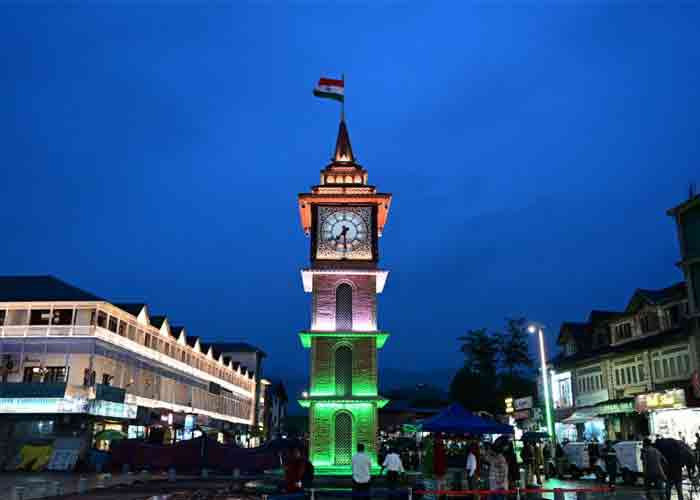
August 5 continues to symbolize two sharply contrasting narratives for India and Pakistan. While India marks the anniversary of the 2019 constitutional changes that revoked the special status of Jammu and Kashmir and fully integrated the region into the Union, Pakistan observes the day as ‘Youm-e-Istehsal’ (Day of Exploitation), alleging that the move represented the suppression of the people of Jammu and Kashmir.
Seven years after the constitutional changes, the debate remains deeply contested. However, the contrasting developments on either side of the Line of Control (LoC) continue to shape the competing narratives.
According to official Government of India data, Jammu and Kashmir has witnessed significant infrastructure and development initiatives since 2019. Investment proposals worth thousands of crores have been announced, while the completion of the Udhampur-Srinagar-Baramulla Rail Link has connected the Kashmir Valley with the rest of the country through the Chenab Rail Bridge, the world’s highest railway bridge. Vande Bharat train services were introduced on the route in June 2025.
The region has also seen the establishment of major educational and healthcare institutions, including an All India Institute of Medical Sciences (AIIMS), along with campuses of the Indian Institute of Management (IIM) and the Indian Institute of Technology (IIT). Official figures have also highlighted record tourist arrivals in recent years, exceeding two crore visitors before the April 2025 terror attack in Pahalgam temporarily affected the tourism season.
At the political level, the restoration of grassroots democratic institutions through Panchayat, District Development Council (DDC) and Assembly elections has been cited as another milestone in the post-2019 period, with increased participation by young representatives and women in local governance.
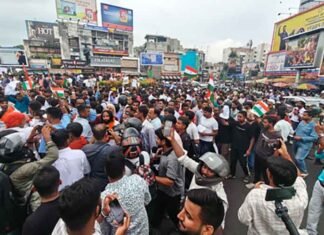
In contrast, Pakistan-occupied Jammu and Kashmir (PoJK) has witnessed repeated public protests in recent years over economic issues, including electricity tariffs, inflation, wheat flour prices and governance-related concerns. Civil society groups and traders’ organisations have alleged that despite generating substantial hydroelectric power, local residents continue to face high electricity costs while power is supplied to Pakistan’s national grid.
The Ministry of External Affairs has previously maintained that Pakistan must address alleged human rights violations and economic exploitation in the territories under its control, describing recurring unrest as a consequence of governance failures and resource exploitation.
Successive protest movements in PoJK have reportedly been met with security measures including curfews, communication restrictions and action against protest groups. India has also dismissed elections conducted in Pakistan-occupied Jammu and Kashmir as lacking legitimacy, describing them as an attempt to legitimise what it considers an illegal occupation.
As both countries continue to mark August 5 in fundamentally different ways, the anniversary remains a reflection of their competing positions on Kashmir, with each side presenting sharply different interpretations of political developments, governance and the realities on the ground.
 FOLLOW NOW