Islamabad, September 28, 2026 (Yes Punjab News)
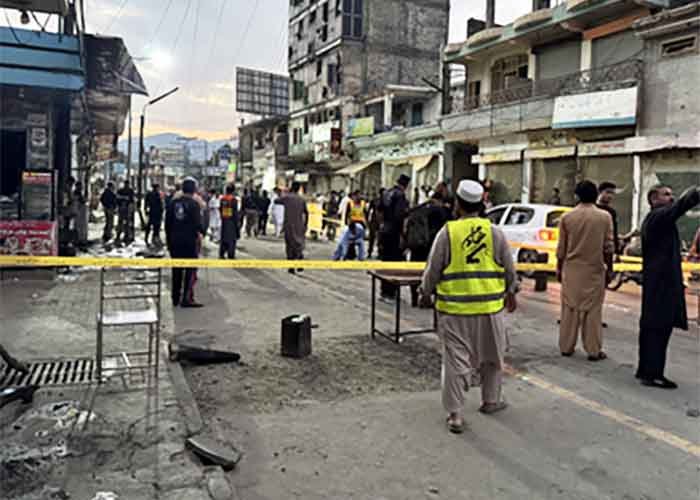
The explosion in Dera Ismail Khan city of Pakistan’s Khyber Pakhtunkhwa province, which claimed 13 lives and injured 20 others over the weekend, has highlighted the deteriorating security situation along the country’s western frontier, according to a report published in Middle East Transparent.
The report said the blast should not be viewed as an isolated incident, but as part of a wider escalation that risks turning Pakistan’s ongoing insurgency into another interstate conflict.
“A reported explosion in Dera Ismail Khan is part of a broader escalation that has already drawn Pakistan into retaliatory strikes inside Afghanistan,” Yusus Kanli wrote in the report. He cautioned that the immediate concern was not the automatic involvement of Turkey and Saudi Arabia in Pakistan’s counterterrorism operations, but the possibility that the expanding insurgency could trigger a conflict between states.
The blast came days after an attack on a police facility in Kohat, Khyber Pakhtunkhwa, on September 18, in which at least 24 people were killed.
Following the Kohat attack, Pakistan carried out airstrikes in Afghanistan’s Kunar and Paktika provinces, claiming that 28 militants had been killed. The Taliban accused Pakistan of killing civilians, while the United Nations confirmed the deaths of a man, a woman and a girl.
The report said the sequence of attacks and retaliatory strikes was more consequential than any single bombing. Militants carry out attacks inside Pakistan, Islamabad blames networks allegedly operating from Afghanistan, and Pakistan subsequently launches strikes across the border, which the Taliban describes as aggression.
Pakistan is facing attacks from multiple insurgent organisations rather than a single identifiable adversary. The Tehreek-e-Taliban Pakistan (TTP) remains the most prominent threat, while the Shura Ittehad-ul-Mujahideen, led by Hafiz Gul Bahadur, claimed responsibility for the Kohat attack.
Kanli warned that a major risk was Pakistan treating the Taliban as an active party to the conflict rather than as an authority that is either unwilling or unable to suppress the TTP. Such a shift, the report said, could transform an insurgency into a conflict between the two countries, with civilian casualties potentially increasing pressure on the Taliban to retaliate.
The developments have also raised questions about the scope of the Mecca Joint Defence Agreement signed by Saudi Arabia, Pakistan and Turkey on August 7. Under the agreement, an armed attack against any one of the three countries would be regarded as an attack against all three.
A statement issued by Pakistan’s Ministry of Foreign Affairs said the agreement reflected the countries’ shared commitment to strengthening collective security and promoting peace, security and stability in the region and beyond.
“The Agreement is intended to strengthen collective deterrence against any act of aggression, and stipulates that any armed attack against any one of the three States shall be regarded as an attack against them all. It further provides for the enhancement of all aspects of defence cooperation among the three States,” the ministry stated.
However, the report noted that publicly available information about the agreement does not specify whether it includes an integrated command, standing forces, a permanent headquarters or a detailed mechanism for assessing threats and activating collective defence.
It also remains unclear whether the agreement covers insurgencies, terrorism, proxy attacks and disputed cross-border operations in the same way as conventional aggression by another state.
“Dera Ismail Khan exposes this ambiguity. A bombing inside Pakistan cannot automatically activate collective defence. The allies would first have to determine who conducted it, whether the perpetrators received external direction and whether the incident constituted an armed attack under the agreement,” Kanli wrote.
The report further cautioned that activating collective defence without reliable attribution could allow militant organisations to draw the alliance into a confrontation with Afghanistan or another regional power through a false-flag operation or an incident with unclear responsibility.
At the same time, it said that failing to provide Pakistan with meaningful assistance could undermine the credibility of the pact.
The report concluded that how Saudi Arabia, Pakistan and Turkey respond to the evolving security situation will be significant in determining whether the Mecca Joint Defence Agreement develops into a functioning security mechanism or remains primarily a declaration of political solidarity.
 FOLLOW NOW