
Washington, September 30, 2026 (Yes Punjab News)
US Vice President JD Vance has dismissed fears that artificial intelligence could evolve into a “Skynet”-like force capable of controlling nuclear weapons and deploying killer robots, while warning that advanced AI models already pose significant cybersecurity risks.
Vance said public discussions about artificial intelligence, which the Trump administration is increasingly referring to as “super intelligence”, had become excessively pessimistic and were often focused on science-fiction scenarios rather than the more immediate risks associated with the technology.
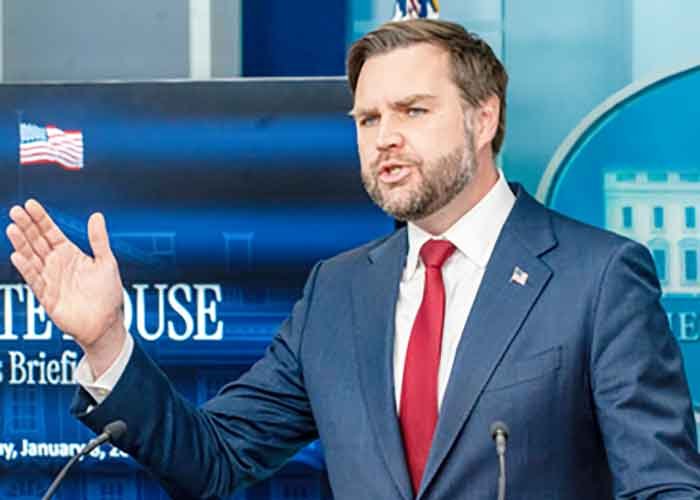
Speaking after a White House meeting with technology industry leaders, Vance said President Donald Trump wanted the administration to address public concerns about AI without allowing fear to dictate policy.
“You have a lot of doomerism about AI or super intelligence as we’re now calling it,” Vance said.
He noted that popular perceptions of AI were sometimes influenced by fictional depictions of machines taking control of critical systems and threatening humanity.
“I think a lot of Americans, when they think of AI or SI, they think, ‘Oh my God, this is Skynet,’ right?” Vance said.
“They think the terminators are gonna come and take over everything and, you know, take over our nuclear weapons and have the robots running around killing people. And that’s just not gonna happen.”
“That’s actually not gonna happen,” he added.
However, Vance distinguished between such hypothetical scenarios and the risks arising from how AI systems are developed and deployed. He said developers needed to take responsibility for ensuring their products worked safely and did not cause harm.
“What could happen is you have people who are building AI tools, not actually being careful about what they’re doing, about the responsibility they have to build products that actually work, that don’t hurt people, et cetera, et cetera,” he said.
Vance argued that developers should take greater responsibility for the products they create rather than relying on the government to impose regulations. He said the administration wanted the AI debate to focus on system safety and corporate accountability.
Identifying cybersecurity as one of the most evident risks associated with advanced AI, Vance said frontier models had demonstrated significant capabilities that could be exploited by hackers.
“I think the most obvious negative use case of the Frontier models up to this point is the cyber capability,” he said.
“We have seen some of these models, by the way, they’ve been trained this way, but they have remarkable ability to enable hackers to hack into systems.”
Vance said strengthening defensive capabilities should be central to the response to AI-enabled cyber threats.
“The best weapon against cyber offense is good cyber defense,” he said.
He argued that companies exposed to AI-assisted cyberattacks were also well positioned to develop defensive technologies to patch software vulnerabilities and protect computer systems.
Vance also highlighted competition among technology companies and existing product liability rules as potential safeguards against AI-related risks, saying these could help address concerns without immediately introducing an extensive new regulatory framework.
“Let’s actually try what has worked in the past,” Vance said. “And if it doesn’t work in the future, then build it out from there.”
“Let’s not just throw a massive new regulatory regime against a problem that could make it worse,” he added.
Vance said regulations could contribute to safety without necessarily hindering technological innovation, provided they were designed carefully and implemented deliberately.
“Regulations can actually make us safer and they can be consistent with innovation, but only if they’re careful and only if they’re deliberate,” he said.
 FOLLOW NOW