
Mohali (SAS Nagar), August 13, 2026 (Yes Punjab News)
Punjab is looking to transform its Sadak Surakhya Force (SSF) into a technology-driven highway safety model by integrating artificial intelligence, drones, satellite imagery and geospatial technologies, with the long-term objective of making the state India’s road safety hub.
The dedicated highway patrol has already reported a significant impact on road safety. According to Punjab DGP Gaurav Yadav, the SSF attended 43,983 road accidents between February 2024 and January 2026 and assisted 47,386 people. Of these, 19,973 received first aid at the accident site, while 27,413 injured persons were shifted to hospitals.
Yadav said road accident fatalities on stretches patrolled by the SSF had declined by 45-48 per cent over the past two years. Fatalities on these specific corridors fell from 1,955 in 2023 to 1,016 in 2024, representing nearly 940 fewer deaths in about a year.
Launched by Chief Minister Bhagwant Mann in Jalandhar on January 27, 2024, the SSF was created in response to Punjab’s high road accident fatality rate, which was averaging 17-18 deaths a day.
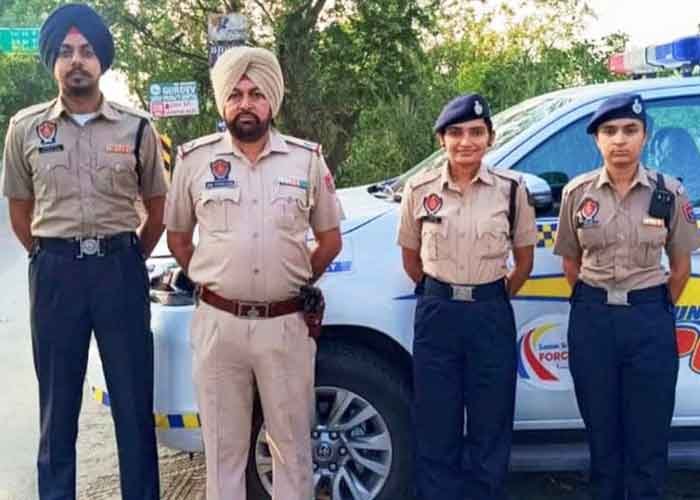
The force currently has 144 high-tech vehicles and more than 1,600 specially trained personnel, including nearly 28 per cent women. Its teams are deployed at intervals of around 30 km across 4,100 km of critical national and state highways and major district roads. The force is dedicated exclusively to highway safety and is not routinely diverted for conventional law-and-order duties.
Built around the “Platinum 10 Minutes” principle, SSF personnel aim to reach accident victims within six to eight minutes. Its vehicles are equipped with speed guns, breathalyzers, e-challan machines, dash cameras and first-aid kits. The average response time has been reported at under seven minutes.
DGP Yadav said the personnel had undergone specialised training in crash investigation and emergency medical response. “The success isn’t just from new vehicles, it’s a shift in philosophy from enforcement to service,” he said.
The SSF has also assisted in wider enforcement and public-service operations, including the recovery of 6 kg of opium and stolen vehicles, helping return cash and gold to their rightful owners, preventing more than 12 suicides and assisting schoolchildren, women travelling late at night and tourists.
Phase II expansion and Vision SSF-2047
The second phase of the SSF expansion is expected to increase coverage from the existing 5,500 km to 6,000 km of state roads.
Under Vision SSF-2047, Punjab plans to develop an integrated road safety ecosystem using satellite data, AI, drones and geospatial technology. The proposed 3D policing model is intended to provide real-time situational awareness, identify emerging risks, predict congestion and support faster police responses.
“Digital enforcement integrating Artificial Intelligence and satellite data is central to Vision SSF-2047, which includes achieving minimal road accidents, fully green mobility corridors and establishing regional research hubs under the Punjab Road Safety and Traffic Research Centre (PRSTRC),” Yadav said.
He said Punjab Police would use satellite communication and geospatial data for incident mapping, congestion prediction and disaster management, while exploring the possibility of integrating the system with a geosynchronous nano or microsatellite of its own.
The Intelligent Transport Management System (ITMS) forms the technological backbone of the project, bringing together AI, IoT sensors and real-time analytics for automated enforcement, smart surveillance and data-based traffic planning.
Automatic Number Plate Recognition (ANPR), predictive analytics and mobile interceptors are also being used for enforcement. Under the broader “Road Safety Punjab” vision, traffic management is being organised around the 7E framework — Engineering, Enforcement, Education, Electronics, Emergency Care, Engagement and Evaluation — representing a shift towards evidence-based and technology-driven road safety management.
The PRSTRC is responsible for research, consultancy and training and is supported by Research Advisory Groups comprising representatives from academia, industry and civil society. Collaborations with IITs, NITs, Plaksha University, Guru Nanak Dev Engineering College (GNDEC), Ludhiana, and Guru Nanak Dev University (GNDU), Amritsar, are aimed at developing regional centres of excellence through shared data, joint projects and internships.
Yadav said the SSF was structurally different from highway safety arrangements in other states, citing Maharashtra Highway Police as an example of a modernised wing within the existing state police rather than a separate dedicated force.
Specialised force focused on saving lives
SDGP (Traffic and Road Safety Punjab) Amardeep Singh Rai said conventional police personnel are trained primarily for the broad responsibilities of law and order, while SSF personnel undergo specialised training specifically focused on saving lives.
He said SSF personnel had received training in emergency response, first aid, including instruction from the Red Cross, and crash investigation.
“The entire force is built around one concept: the Platinum 10 Minutes, which mandates reaching an accident victim within six to eight minutes to provide immediate medical relief before the ambulance or hospital takes over,” Rai said.
He added that SSF personnel were not diverted for VIP duties or local law-and-order assignments and that their key performance indicator remained road safety and assistance to accident victims.
 FOLLOW NOW