
Kathmandu, September 25, 2026 (Yes Punjab News)
Nepal Prime Minister Balendra Shah has proposed a trilateral Himalayan Climate Resilience Mechanism involving Nepal, India and China to strengthen regional cooperation against climate-related risks in the Himalayan region.
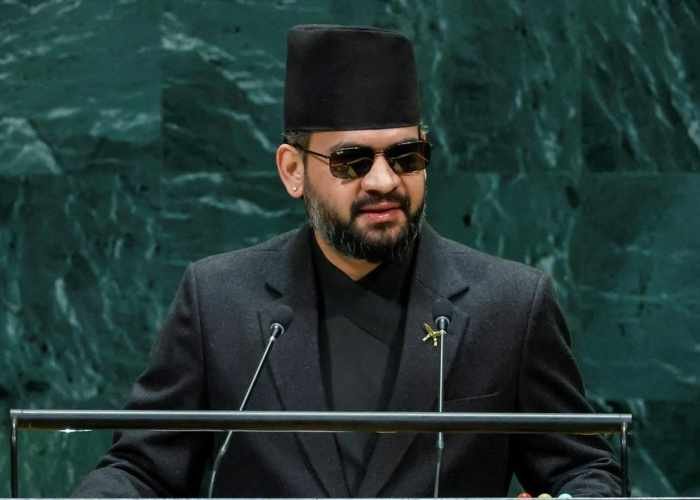
Addressing the 81st session of the United Nations General Assembly in New York, Shah called for closer coordination among the three countries through satellite-data sharing, technical expertise, monitoring of dangerous glacial lakes and stronger regional early-warning systems.
“Let us monitor dangerous glacial lakes. Let us strengthen joint early warning systems. And when disaster strikes, let us coordinate assistance across borders,” Shah said.
His proposal comes after catastrophic floods swept through mountain communities in Nepal on August 26, with the disaster described by many as a “Mountain Tsunami” or “Himalayan Tsunami”. According to Nepal’s National Disaster Risk Reduction and Management Authority, 1,453 people had died and 5,550 remained missing as of Thursday evening, including 636 foreign nationals. Experts have described the disaster as climate change-induced.
Shah said the Himalayas should serve as a platform for international cooperation rather than fragmented information sharing.
“Let the Himalayas become a laboratory of international cooperation rather than a frontier of fragmented information,” he said.
Highlighting Nepal’s own climate initiatives, Shah said forest cover had been restored to nearly half of the country’s territory, while hydropower generation was being expanded to meet clean-energy requirements and displace fossil-fuel-based energy abroad. He also pointed to growing electric-vehicle adoption and efforts to strengthen climate adaptation at the local level.
Shah stressed that Nepal contributes less than 0.1 per cent of global greenhouse gas emissions but faces disproportionate consequences from climate change.
“We did not create this crisis, yet we are paying a colossal price for it,” he said, warning that retreating glaciers, unstable mountain slopes and increasingly unpredictable rivers were threatening development gains.
He described the climate crisis as a “development emergency” for Nepal, saying disasters destroy roads, bridges, schools, homes, farms, livelihoods and clean-energy infrastructure, while forcing vulnerable countries to borrow for reconstruction.
The recent floods along the Bhotekoshi and Trishuli river corridors caused extensive destruction to settlements, roads and bridges and damaged homes, schools and livelihoods.
A Rapid Disaster Needs Assessment prepared by a joint technical team of Nepal’s National Planning Commission and the National Disaster Risk Reduction and Management Authority estimated losses from the floods at $2.69 billion. It projected that $4.77 billion would be required for reconstruction and recovery, equivalent to around 10 per cent of Nepal’s GDP.
Shah called on the international community to go beyond immediate relief and reconstruction, stressing the need for responsibility, reparation and resilience.
“This is why this Assembly must note six words – relief, rehabilitation, reconstruction, and also responsibility, reparation, resilience,” he said.
He also sought greater grant-based international support for climate-vulnerable developing countries, arguing that disaster-hit nations should not be pushed further into debt.
“The Loss and Damage Fund, the Global Environment Facility, and other financing mechanisms remain grossly inadequate,” Shah said, while criticising cumbersome procedures for accessing climate finance.
He warned that the Nepal floods offered a glimpse of a future marked by increasingly severe climate extremes and called for a shift from ad hoc disaster responses to a culture of preparedness.
Shah urged countries to invest in resilient infrastructure, insurance and innovation, reduce fossil-fuel dependence and strengthen systems capable of warning and protecting communities before disasters strike.
“Let us reduce fossil fuel dependence. Let us build systems that warn, alert, and save lives. Let us reform the order that leaves the weakest with the least power,” he said.
 FOLLOW NOW