
New Delhi, August 13, 2026 (Yes Punjab News)
Pakistan’s Inter-Services Intelligence (ISI) has undertaken a major overhaul of its overground worker (OWG) network in Jammu and Kashmir following the setbacks suffered by Pakistan during Operation Sindoor, according to intelligence officials.
Operation Sindoor, launched by the Indian armed forces in response to the Pahalgam terror attack, targeted terror infrastructure in Pakistan and Pakistan-occupied Kashmir (PoK). The operation subsequently prompted Pakistan to restructure its support network in Jammu and Kashmir and rebuild infrastructure associated with terror groups including Jaish-e-Mohammed (JeM), Lashkar-e-Taiba (LeT) and Hizbul Mujahideen, officials said.
According to officials, the ISI has dismantled much of its older OWG network and begun recruiting younger operatives, including girls. Many of the new recruits are reportedly teenagers aged around 15-16.
Unlike the earlier system, in which JeM and LeT maintained separate OWG networks, the new recruits are reportedly not permanently associated with any particular terror organisation.
The older network also consisted largely of individuals with police records and established links to specific terror groups, making them easier for security agencies to identify and monitor. New recruits, by contrast, are allegedly assigned individual tasks and then withdrawn from the network.
An Intelligence Bureau official said the new OWGs are primarily being used to transport small consignments containing one or two pistols. They are generally not tasked with carrying larger weapons such as AK-47 rifles.
The weapons are reportedly transferred through a chain of operatives. One person delivers a weapon to a designated location, where another operative collects it and eventually passes it to an agent responsible for delivering it to the intended attacker.
Officials said consignments may change hands three, four or even five times, making it difficult for security agencies to establish the complete chain.
“This constant changing of hands has posed a big challenge for the security agencies,” an official said, adding that the limited involvement of individual recruits reduces the trail available to investigators.
Officials believe the use of small arms points towards a strategy focused on targeted killings rather than large-scale attacks in the Valley. Two recent incidents in which a head constable and two migrant workers were killed are being examined in this context.
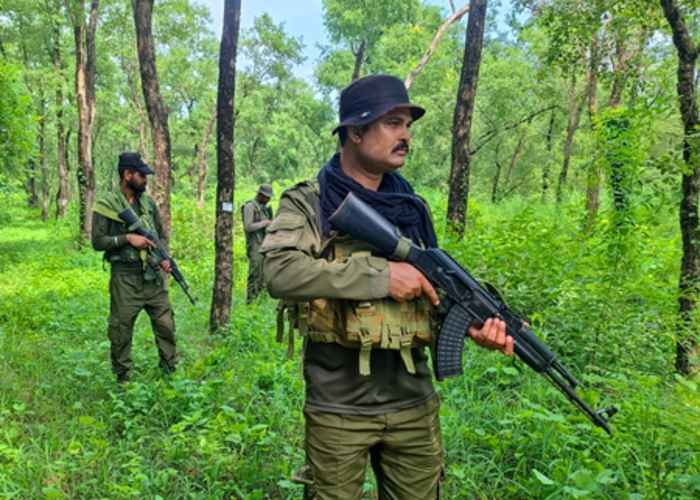
At the same time, intelligence agencies suspect that Pakistan-backed terrorists are increasingly relying on jungle warfare. Several terrorists are believed to be hiding in dense forest areas of Jammu and Kashmir, where difficult terrain and thick vegetation complicate search operations.
Security agencies are also examining the reported use of Chinese-made communication devices known as Ultra Sets. Officials say the devices combine smartphone-like capabilities with military-grade radio technology and can facilitate communication without conventional local telecom or SIM networks.
According to an official, such devices can transmit short encrypted data bursts through radio links to cross-border relay stations and communication infrastructure linked to Pakistan.
The evolving tactics have prompted security agencies to intensify surveillance of suspected support networks and monitor the movement of weapons and communications equipment across Jammu and Kashmir.
 FOLLOW NOW