
New Delhi, August 7, 2026 (Yes Punjab News)
Intelligence assessments indicate that Pakistan-based terror outfit Jaish-e-Mohammed (JeM) may currently be focusing more on ideological mobilisation and recruitment rather than directly executing terror attacks, officials said.
The outfit was among the groups reportedly hit hard during Operation Sindoor. Since then, JeM’s leadership has largely remained silent, with little public communication or claims of operational activity.
“There has been little indication of any revival within the Jaish-e-Mohammed. The leadership has remained quiet, and there has been hardly any significant activity reported for nearly a year now,” an official said.
However, intelligence agencies have observed a different pattern with Lashkar-e-Taiba (LeT), which has continued recruitment activities and operational coordination with Islamic State Khorasan Province (ISKP). The group is also believed to have shifted some training infrastructure closer to the Pakistan-Afghanistan border.
LeT’s main training facility at Muridke near Lahore was among the targets destroyed during Operation Sindoor, while JeM has not carried out any major attack since the operation. However, the outfit’s ideology has surfaced in investigations into multiple terror-related cases in India.
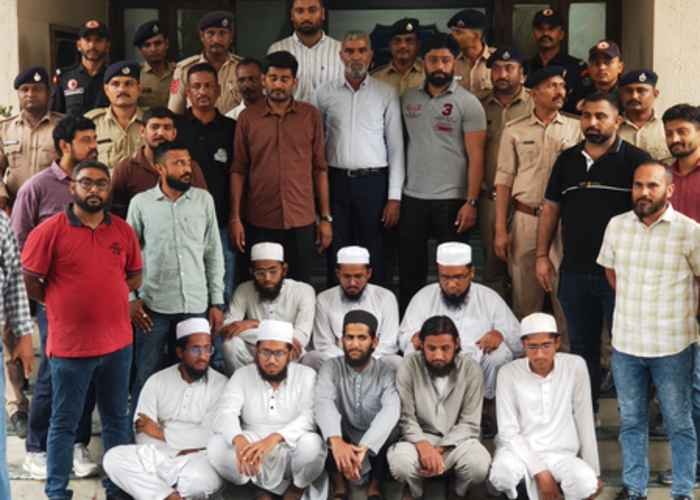
In the Faridabad module linked to the Red Fort car bomb blast case, investigators found that several accused were influenced by JeM’s ideology. Similarly, the Gujarat Anti-Terrorism Squad (ATS) arrested more than five individuals who were allegedly conducting Improvised Explosive Device (IED) trials and planning a major attack in the state. Investigators found that the accused were inspired by JeM, though no direct operational link with the outfit was established.
A similar pattern emerged in West Bengal, where the Special Task Force (STF) arrested an operative accused of collecting sensitive information for Pakistan’s Inter-Services Intelligence (ISI) and allegedly planning an assassination attempt on West Bengal Chief Minister Suvendu Adhikari. Investigators found that the accused, Hamim Mondal, was also influenced by JeM ideology.
An Intelligence Bureau official said the trend represents a new challenge for security agencies.
“The probe has not found any direct involvement of the Jaish-e-Mohammed in these cases. The accused were in contact with their handlers. While some appear to have acted independently, others were assigned specific tasks. The common thread is that JeM has managed to spread its ideology without being directly involved in carrying out attacks,” the official said.
According to officials, maintaining ideological influence allows JeM to remain relevant while providing time to rebuild its network. Although recruitment in Pakistan has reportedly declined due to the prolonged silence of its leadership, security agencies believe incidents in India could be used as propaganda tools to attract new recruits.
Another official suggested that the strategy could be linked to Pakistan’s ISI, which may be attempting to maintain distance from direct attacks while encouraging India-based modules influenced by JeM ideology.
“Using individuals inspired by the organisation rather than direct operatives provides operational deniability while allowing the group to preserve its ideological footprint,” the official said.
Security agencies believe JeM may continue relying on this approach for some time — attempting to regroup while ensuring that its ideology remains active among potential recruits.
Officials also claimed that social media platforms are being used to identify and influence vulnerable Indian youth, with individuals such as Shahzad Bhatti allegedly assisting efforts to spread JeM propaganda and recruitment narratives.
 FOLLOW NOW