

Singapore, May 30, 2026
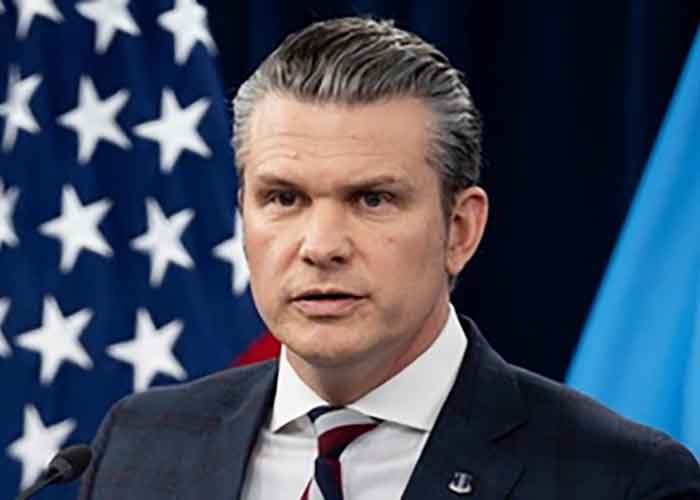
US Defence Secretary Pete Hegseth on Saturday called for finding a “balance” in the transfer of wartime operational control (OPCON) to South Korea in a way that respects the roles the US military has played for decades.
Hegseth made the remarks at a defence forum in Singapore amid growing concerns over what appears to be differing views between Seoul and Washington over when and how the transition should proceed.
“I think we have to find the balance of where our military plans and the responsibilities that US uniformed members have had for decades now (are) honored, as we phase over to wartime OPCON transfer for the Republic of Korea, which we welcome the fact that they want that,” he said during a session of the Asia Security Summit, also known as the Shangri-La Dialogue.
Seoul has proposed retaking wartime OPCON from Washington as early as in 2028 as it seeks to complete the transfer before the Lee Jae Myung administration’s five-year term ends in 2030, Yonhap news agency reported.
However, doubts have emerged over whether Washington sees eye to eye with Seoul on such a timeline after US Forces Korea Commander Gen. Xavier Brunson suggested the two sides aim to meet the conditions required for the OPCON transfer by no later than the first quarter of 2029.
South Korea handed over operational control of its troops to the US-led UN Command during the 1950-53 Korean War. It was then transferred to the allies’ Combined Forces Command when the command was launched in 1978.
Brunson, who was also taking part in the regional forum in Singapore, stressed the importance of ensuring proper military capabilities and readiness for the OPCON transition.
“The position that we have within the (Korean) peninsula … is important,” the USFK chief said.
“But what’s also important (is) that we have the right capabilities, the right place and the right time,” he added, while also stressing the importance of taking those elements into “actual perspective.”
Hegseth reiterated his positive view on Seoul’s strong will to retake the wartime OPCON, calling it a “breath of fresh air” that an ally wants to regain the control “more quickly.”
“It is an instinct we want to continue to incentivize,” he said. “I think it provides even more optionality for both the Koreans and the United States there on the (Korean) peninsula going forward, which is a very good thing.”
Regarding South Korea’s push for a nuclear-powered submarine program, Hegseth reaffirmed US support for allies wanting to expand their own undersea warfare capacity, which he said would enhance deterrence and regional stability.
“Allies and partners seeking similar capabilities in their own defense and in regional stability makes a lot of sense to us,” he said.
As the US’ undersea warfare capabilities are “unmatched,” its allies having a similar capability will create “strategic dilemmas” for potential adversaries, the secretary highlighted.
“There are challenges, and how we get past them will require collaboration, but we are very much committed to that,” he added, without elaborating further.
The US gave backing for South Korea to build conventionally armed nuclear-powered attack submarines following their leaders’ summit in October.
Earlier this week, South Korean Defence Minister Ahn Gyu-back announced a road map for the country’s nuclear-propelled submarine program, seeking to domestically develop such assets and launch the first vessel in the mid-2030s.
Hegseth also commended the South Korean leadership for its decision to take greater responsibility for security, calling it a “hard-nosed” decision that came from “seeing the world as it is” and a “path” that he said he would like to see other allies and partners follow.
“President Lee’s decision to increase defense spending to the new global standard of 3.5 per cent (of the gross domestic product) and to assume greater responsibility for its conventional defense reflects simply a clear-eyed understanding of the threat environment,” he said.
“We applaud the pragmatism and leadership demonstrated by Seoul. The region will be far more stable and more secure when other allies and partners follow that path.”
Later in a Q&A session, USFK Commander Brunson was asked to clarify what he meant by his description of the Korean Peninsula as a “dagger” toward China.
“What I said was trying to describe the operating environment because what’s incredibly important … is about being able to describe the environment where we’re working in,” he said, citing his earlier suggestion of viewing geography from a different strategic perspective based on an “east-up” map orientation of the region.
“By changing our perspective, we take into account how others might see us in the region,” Brunson added.
His remarks earlier drew criticism from Beijing, with the Chinese Embassy in Seoul issuing a statement accusing him of “crossing the line” by revealing his belligerence.(Agency)
 FOLLOW NOW