



The results of Punjab’s urban local body elections are not merely municipal results. They are the first major political test since the 2022 Assembly election and the first meaningful indicator of the political landscape that may shape the 2027 contest.
The headlines are straightforward: AAP has emerged as the dominant force. But the deeper story lies not in who won a ward or a municipal corporation. It lies in how Punjab’s political scene is changing.
From Congress Dominance to AAP Dominance
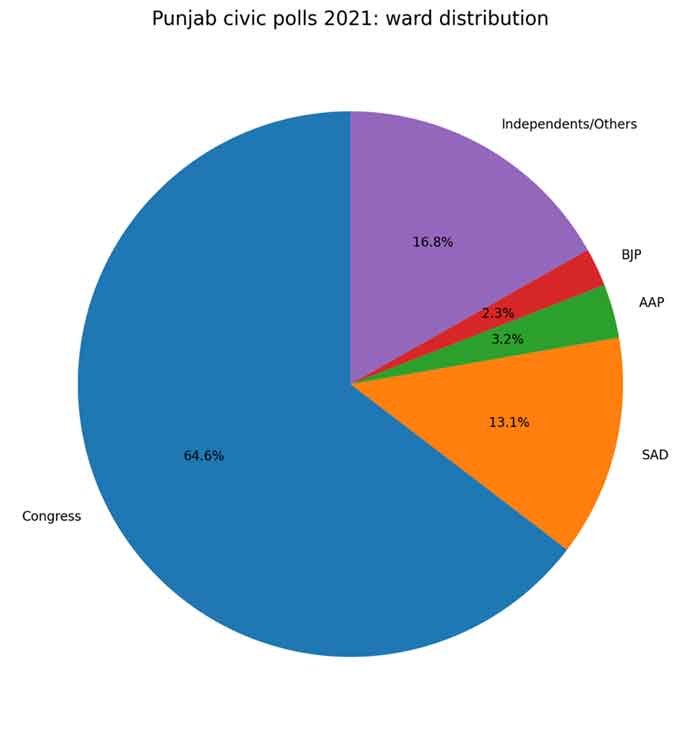
The most striking feature of the results is the dramatic reversal from 2021.
In the 2021 civic elections, Congress dominated urban Punjab. Five years later, AAP has become the principal urban political force.
Chart 1: Punjab Urban Local Bodies – Ward Tally 2021 vs 2026

The numbers reveal a remarkable political realignment. Congress fell from nearly 1,400 wards in 2021 to less than 400 in 2026.
AAP moved from a marginal presence in municipal politics to nearly 1,000 wards.
Such shifts are rare in democratic politics. They usually occur when voters begin to perceive one party as the primary governing force and another as a declining alternative.
That appears to be what has happened in Punjab’s urban political space. 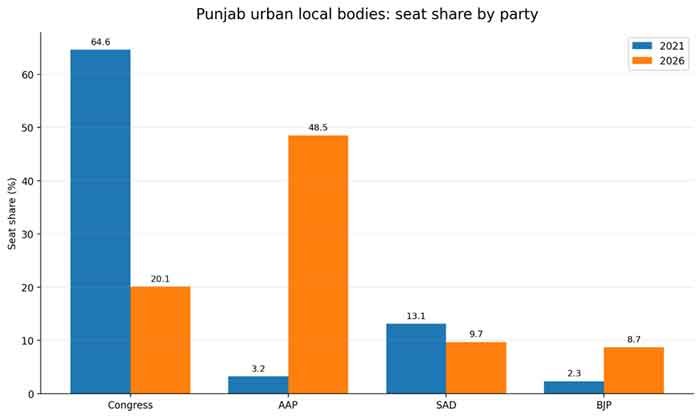
The Real Story: A Massive Transfer of Political Space
Election results are often described in terms of gains and losses. Yet the more important question is where those gains and losses originated.
Chart 2: Net Gain and Loss in Wards (2021–2026)
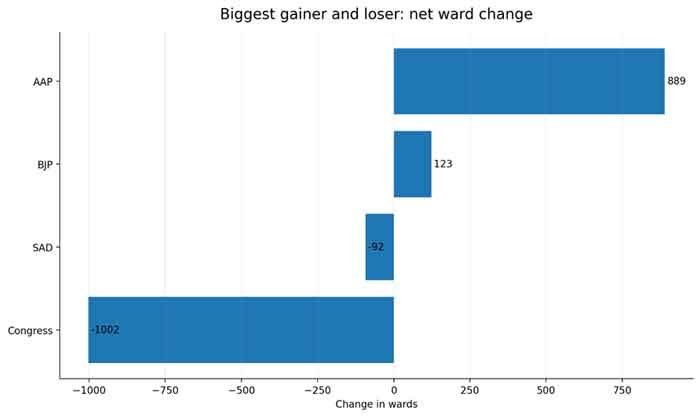 AAP gained nearly 900 wards.
Congress lost more than 1,000.
The relationship is too large to ignore. A substantial portion of Congress’s traditional municipal support appears to have migrated directly towards AAP.
This is significant because it suggests that AAP is no longer merely attracting protest voters. It is increasingly occupying the political space that Congress once considered its natural territory, by building its own strong cadre both in rural and urban areas.
Punjab’s Urban Map Has Been Redrawn
The 2026 ward distribution provides an even clearer picture of the current political landscape.
Chart 3: Punjab Civic Elections 2026 – Ward Distribution
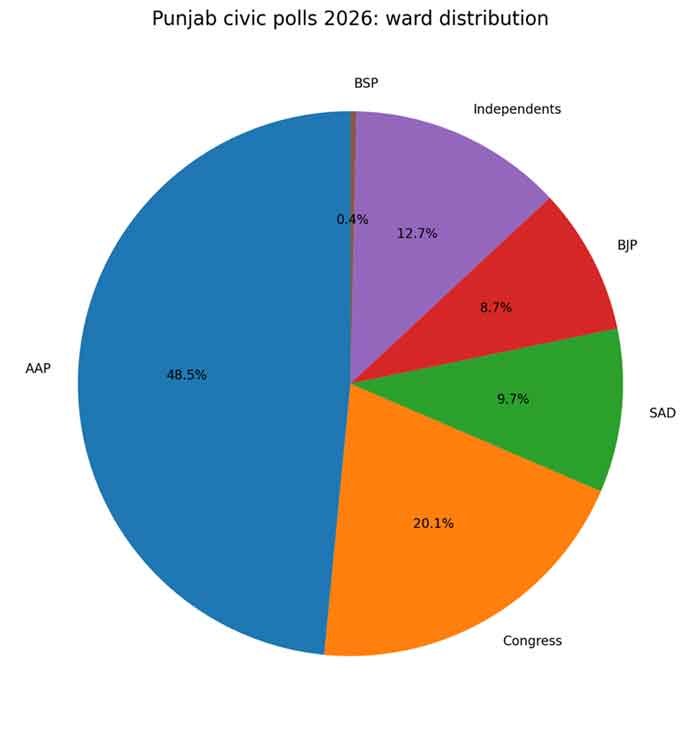 AAP today controls almost half of all urban wards in Punjab. Congress remains the second-largest force but at a considerable distance.
The Akali Dal and BJP continue to retain influence in specific pockets but are no longer shaping the statewide urban narrative.
The significance of this chart is not merely numerical. It demonstrates that Punjab currently has one dominant party and several competing opposition parties rather than two clearly defined political poles.
That distinction matters enormously in a first-past-the-post electoral system.
The Rural Results Tell the Same Story
The urban verdict becomes even more significant when viewed alongside the rural local body elections held recently.
AAP performed strongly not only in cities and towns but also across rural Punjab.
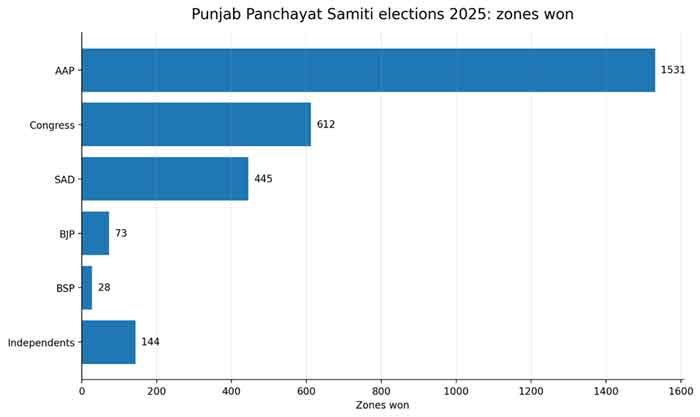
It won approximately 63 per cent of Zila Parishad zones and nearly 54 per cent of Panchayat Samiti zones.
Chart 4: Zila Parishad Election Results

Chart 5: Panchayat Samiti Election Results
Historically, Punjab’s urban and rural voting patterns have not always moved together.
Urban voters often prioritise municipal services, business conditions and local infrastructure.
Rural voters tend to focus more on agriculture, local leadership networks, caste equations and village-level issues.
AAP’s success across both levels therefore carries greater significance than either result taken in isolation.
It suggests that the party’s organisational structure now extends across much of Punjab’s local governance framework.
AAP’s Emerging Rural-Urban Coalition
Perhaps the most revealing chart is the comparison of AAP’s performance across different levels of local government.
Chart 6: AAP’s Rural and Urban Performance

The data shows remarkable consistency.
AAP secured around:
- 63% of Zila Parishad zones
- 54% of Panchayat Samiti zones
- 49% of urban municipal wards
Few parties manage to achieve comparable strength simultaneously in rural and urban institutions.
This is one reason why the results deserve attention beyond municipal politics.
They indicate organisational depth rather than merely electoral popularity.
Congress: The Biggest Strategic Challenge
The party facing the most serious questions after these elections is Congress. Its challenge is not simply electoral decline. It is the loss of political centrality. For decades, Punjab politics largely revolved around Congress and the Akali Dal.
Today, that structure has changed.
AAP occupies the central position.
Congress is struggling to reclaim it.
Unless Congress resolves its leadership uncertainties and presents a compelling alternative narrative, these results risk becoming part of a longer-term trend rather than a temporary setback.
BJP’s Incremental Growth
The BJP’s performance deserves a more nuanced assessment. The party remains far from becoming Punjab’s principal challenger. Yet it has improved significantly compared with 2021. Its influence remains concentrated in specific urban pockets, but the direction of movement is positive. The challenge for BJP is that electoral expansion alone will not be sufficient to take it to the ruling chair.
Punjab is different; and that must be understood. Punjab’s politics is shaped much by emotion, identity, federal concerns, agriculture and community confidence. To win elections it will have to win hearts.
The party must address those issues if it hopes to transform local gains into statewide relevance.
The Akali Dal’s Continuing Search for Revival
The Shiromani Akali Dal remains one of Punjab’s most important historical political institutions.
However, these results indicate that dissatisfaction with the ruling party is not automatically translating into support for the Akalis. The party’s organisational recovery remains incomplete. Its traditional support base remains fragmented amongst many factions competing in the panthic space, trying to prove who is the true saviour of the Panth. Its leadership challenges remains unresolved.
Most importantly, many younger voters have little direct memory of the Akali Dal’s years in power. The Sikh GenZ is edgy and highly influenced by the social media which is not in favour of the moderate Akali Dal.
That makes organisational renewal and a compelling future vision more important than relying on past glory which has been tarnished post 2015. It may have recovered, but the scars remain.
Why AAP Should Not Become Complacent
The temptation after such results is to declare the next election decided.
Punjab’s political history warns against such conclusions.
The same electorate that strongly backed Congress in the 2021 civic elections delivered a landslide Assembly mandate to AAP in 2022.
This is a strong message for AAP to not to be complacent keeping in view that the Punjab’s electorate can change its mind over a minor incident. And the emergence and impact of the Waris Panjab De and polarisation effect thereof will be dominant only in the 2027.
Punjab’s voters are pragmatic and often impatient. They reward governments that deliver. They punish governments that fail. Local body victories create lot of expectations.
Law and order, freebies, roads, sanitation, drainage, water supply, municipal administration, corruption, employment and local development will now become the standards by which voters judge the ruling party.
The advantage that AAP enjoys today can only be sustained through rapid governance restructuring in areas of its Achilles heel: that is law and order and perception of corruption.
The Real Message of the Election
The most balanced conclusion is neither triumphalist nor pessimistic.
AAP has clearly consolidated its position.
Congress has clearly declined.
BJP has improved but remains limited.
The Akali Dal remains in search of recovery.
Most importantly, Punjab’s opposition remains fragmented.
That fragmentation may ultimately prove more important than any individual ward result.
Because elections are not decided only by how strong the leading party is.
They are also decided by how divided its challengers remain.
And that is the central political lesson of Punjab’s 2026 civic verdict.
Punjab’s Civic Verdict is clear: AAP Consolidates, Opposition Searches for Direction.

About the author:
Gurpartap Singh Mann, Ex Member Punjab Public Service Commission
- Gurpartap Singh Mann is a farmer and former Member of the Punjab Public Service Commission. He has earlier served as Chief General Manager, Punjab Infrastructure Development Board.
- An Engineer and MBA by qualification, he writes on governance, agriculture, and socio-political issues concerning Punjab.
- He was earlier Spokesperson of Punjab Congress and founder Chairman of its Social Media Cell.
- His father, S. Bhupinder Singh Mann, former Member of the Rajya Sabha, is a prominent Kisan leader and founder of the Bharti Kisan Union in Punjab and All India Kisan Coordination Committee at National Level
 FOLLOW NOW