


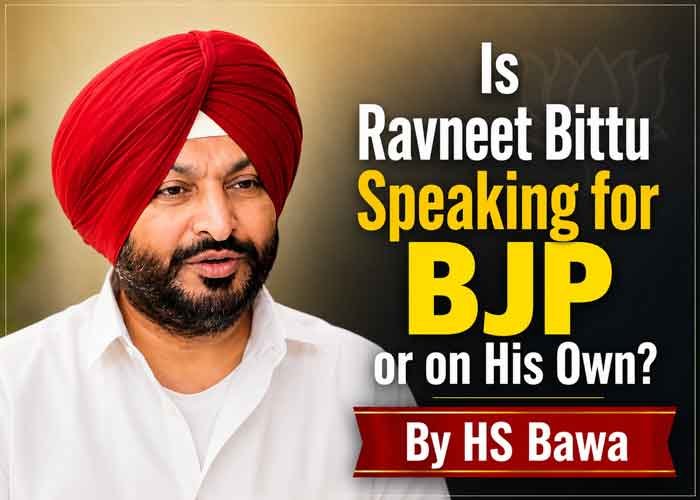
By HS Bawa
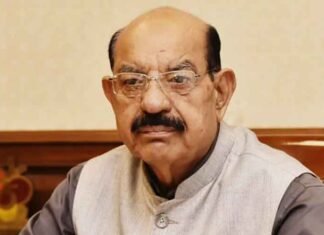
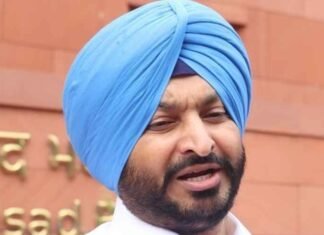
Union Minister Ravneet Singh Bittu has remained in the spotlight ever since he was inducted into Prime Minister Narendra Modi’s Council of Ministers despite losing the Ludhiana Lok Sabha election on a Bharatiya Janata Party (BJP) ticket.
Known throughout his political career as an outspoken leader, Bittu became even more vocal after assuming ministerial office. On Punjab-related issues, particularly after the release of Diljit Dosanjh-starrer Satluj, he has emerged as one of the BJP’s most visible voices in the state, dominating the political discourse with his sharp and often combative statements.
His omission from the BJP’s latest Rajya Sabha nominations triggered speculation about his political future. Some even wondered whether he might eventually lose his ministerial berth. Yet, the fact remains that he continues to serve in the Union Cabinet, making every public statement he delivers politically significant.
The release of Satluj itself surprised many. A film that had remained unreleased for years after facing objections over certification suddenly became available on a global OTT platform, reopening a debate that many believed had long subsided.
For Bittu, however, the issue was deeply personal.
The film revolves around the life and work of human rights activist Jaswant Singh Khalra and includes the portrayal of former Punjab Chief Minister Beant Singh, Bittu’s grandfather. It was only natural that Bittu would react strongly. Any grandson would be sensitive to how his grandfather is depicted, particularly when the grandfather remains one of the most consequential and controversial figures in Punjab’s modern political history.
His emotional response, therefore, is understandable.
What is less understandable is the manner in which that response has unfolded.
Punjab has paid an enormous price for decades of violence and division. Political leaders, especially those occupying constitutional offices, carry a greater responsibility to choose their words carefully. Passion is understandable; inflammatory language is not. Leaders are expected to lower temperatures, not raise them. They are expected to unite, not deepen existing fault lines.
That brings us to the larger political question.
Is Ravneet Bittu speaking on behalf of the Bharatiya Janata Party, or is he speaking primarily for himself?
The question is not academic. As a Union Minister and one of the BJP’s prominent faces in Punjab, his statements are naturally perceived as reflecting the thinking of both the party and the Union Government unless clarified otherwise.
Interestingly, there appear to be two schools of thought within the BJP.
One believes Bittu’s aggressive positioning is politically beneficial and helps the party sharpen its messaging in Punjab. The other appears to favour a more measured approach, fearing that such rhetoric could undermine the BJP’s continuing efforts to broaden its acceptability among Punjabis and Sikhs.
That uncertainty is reflected outside the party as well.
Punjab BJP president Kewal Singh Dhillon did write to the Union Government seeking a review of the developments surrounding Satluj, a move that reportedly resulted in the constitution of a review committee. However, beyond that institutional response, most senior BJP leaders in Punjab have refrained from publicly endorsing Bittu’s aggressive narrative. Former Chief Minister Capt Amarinder Singh, former state president Sunil Jakhar, working president Ashwani Sharma and several other senior leaders have largely maintained public silence on the controversy. Whether that silence signifies agreement, disagreement or a conscious political strategy remains known only to the party, but it has inevitably fuelled speculation over whether Bittu is articulating the BJP’s official position or primarily his own.
After nearly ten days, however, a few respected voices associated with the BJP offered a more nuanced perspective.
Former IPS officer and former National Commission for Minorities Chairman Iqbal Singh Lalpura urged caution while commenting on the controversy. Senior Supreme Court advocate H.S. Phoolka, who recently joined the BJP, maintained that films depicting historical events should not be opposed merely because they portray uncomfortable truths. Former Punjab minister Manoranjan Kalia also adopted a restrained approach, suggesting that such sensitive issues should be handled with maturity and caution.
Their interventions demonstrated that even within the BJP’s wider political fold, there is no complete unanimity on how sensitive chapters of Punjab’s history should be addressed.
Ultimately, this debate is no longer about one film.
It is about political messaging, leadership and responsibility.
If Ravneet Bittu is articulating the BJP’s official position, the party owes it to Punjab to say so clearly. If he is expressing his personal views, that distinction should be equally clear.
Political ambiguity may sometimes serve electoral strategy, but it seldom serves public understanding.
And finally, one cannot help feeling that Ravneet Bittu missed a rare opportunity.
To become a Union Minister at a relatively young age despite losing an election is an extraordinary political endorsement. It was, in many ways, a God-sent opportunity to rise above partisan battles and grow into the stature of a statesman.
Sadly, on this occasion, that opportunity appears to have been lost.
 FOLLOW NOW