
New Delhi, April 25, 2026
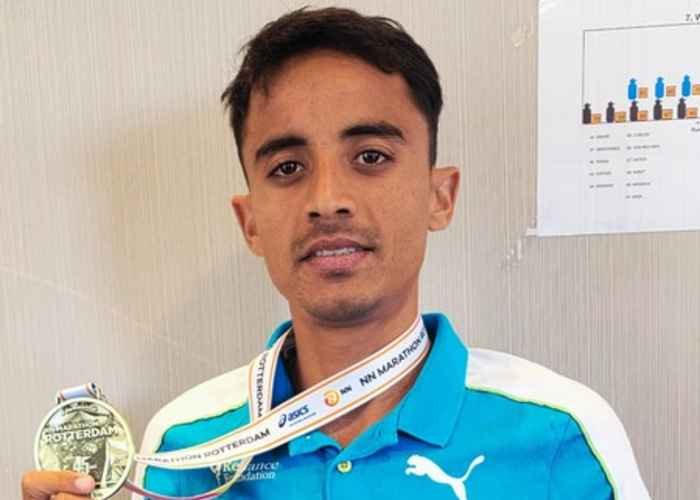
India’s emerging long-distance runner Sawan Barwal shared his thoughts on his groundbreaking marathon debut, describing it as a milestone of personal and national pride after he set a new record at the 2026 Rotterdam Marathon.
Hailing from the hills of Joginder Nagar in Himachal Pradesh, Barwal clocked 2:11:58 in his first full marathon, breaking a 48-year-old national record set by Shivnath Singh in 1978. The achievement marked a major milestone for Indian athletics, ending one of its longest-standing records.
Recalling the moment he crossed the finish line, Barwal admitted that the magnitude of his feat did not immediately sink in. “When I crossed the finish line at the Rotterdam Marathon, I honestly wasn’t thinking about the record at all. The race had taken everything out of me, especially in the final stretch, so my only focus was to finish,” Barwal told Olympics.com.
He added that the realisation came only moments later. “It was only after a few moments that I realised I had broken Shivnath Singh’s record. That’s when it really hit me – this was something that had stood for 48 years. It felt special, not just personally but for Indian athletics as a whole.
Barwal’s debut marathon was far from straightforward, with challenging weather conditions testing his endurance, particularly towards the end. “The last couple of kilometres were the toughest part of the race. The cold and wind made it very difficult, especially after I poured water on myself to stay cool. My body started reacting badly, and I did feel dizzy and lost balance a couple of times.”
Despite the physical toll, the 27-year-old emphasised the role of mental strength in pushing through adversity. “But at that point, it becomes more of a mental battle than a physical one. I just kept telling myself that I had come too far to stop. Finishing the race became the only goal, and that mindset helped me push through.”
Barwal’s journey to the marathon has been shaped by years of competing across distances, from middle-distance track events to longer road races. Speaking about the transition, he said, “It’s not easy at all. The 1500m and even 5000m require speed and explosive strength, while the marathon is all about patience, rhythm, and endurance.”
He further highlighted the shift in both physical preparation and mindset. “The biggest challenge is changing your mindset – you go from thinking in minutes to thinking in hours. Physically, too, the training is very different. Building endurance while maintaining some level of speed is the toughest balance to achieve, and that’s something I’ve worked on over the years.”
The move to the marathon, he revealed, was a gradual and natural progression rather than a record-driven decision. “The decision came gradually. After competing in track events and longer road races, I felt my strength was more suited to endurance. Over time, with guidance from coaches and my performances in longer distances, the marathon became a natural progression.”
He added, “The record wasn’t really on my mind when I made that decision. The focus was more on performing well and improving step by step.”
Looking ahead, Barwal has set his sights firmly on the 2028 Summer Olympics, with the marathon expected to be his primary focus. “Yes, the marathon will definitely be a major focus going forward, especially with the LA 2028 Olympics in mind. Having started with a good performance, I want to build consistency in this event.”
He also outlined a structured approach to his future goals. “In the short term, I want to recover well and improve my timing further. In the mid term, my focus is on performing strongly at major events like the Asian Games and other international races. Long term, the goal is to represent India at the Olympics and aim for a strong finish there.”
For Barwal, breaking a decades-old record is just the beginning. “This record is just a starting point – I know there’s a lot more to achieve.”
Reflecting on why the previous national mark had endured for nearly five decades, he pointed to changes in the sporting ecosystem. “I think there are many reasons. Earlier, marathon running in India didn’t have the same level of exposure, scientific training, or international competition opportunities that we have now. The record by Shivnath Singh was ahead of its time, and it set a very high benchmark.”
He signed off on an optimistic note for the future of Indian distance running. “Today, with better facilities, coaching, and exposure, athletes are able to push those limits further. I’m happy that I could finally break it, and hopefully, it motivates more runners to go even faster in the future.”(Agency)
 FOLLOW NOW