

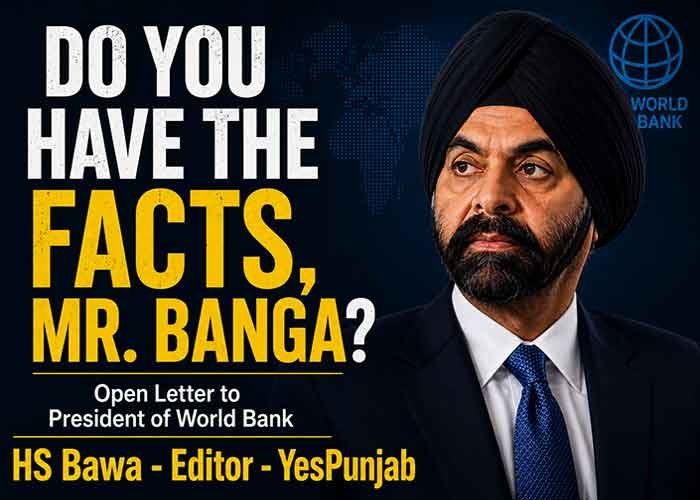
Dear Mr. Ajay Singh Banga,
I listened carefully to your recent remarks about Punjab during an interview that has since gone viral across social media platforms.
Speaking on Punjab, you said:
“If you go there today, you will find all these young kids who sold off their farms. They were really rich for about four years. They buy a great SUV, a big television, smoke a lot, drink a lot, do all kinds of other stuff and four years later, they are broke and they end up in a shanty town of an urban centre, basically trying to find gig economy jobs. Nothing wrong with that, but that’s nothing compared to what they could have been if they had a chance to be productive; you need cooperatives, you need technology that gives the farmers access to better seeds, better fertilisers.”
When you speak, the world listens.
More importantly, the world assumes that your observations are backed by facts, research and evidence. Your remarks are not treated as casual opinions. They are accepted as informed conclusions from a person occupying one of the most influential positions in global finance.
That is why I wish to ask a simple question:
What facts, studies, surveys, datasets, research papers or evidence form the basis of these assertions?
Was your statement based on a World Bank study?
Was it based on Government of India data?
Was it based on a peer-reviewed academic paper?
Was it based on a field survey?
Was it based on anecdotal observations?
What sample size was examined before such conclusions were drawn?
Which districts of Punjab were studied?
What percentage of Punjabi farmers or farming families were found to fit the description you presented?
How many Punjabi youth sold their farms, became wealthy for a few years, bought luxury items, went broke and eventually landed in urban slums looking for gig-economy jobs?
If such data exists, kindly share it.
I ask these questions because your remarks have travelled across the world and contributed to perceptions about an entire state and its people.
Let me make it clear that I am not suggesting Punjab has no problems.
It does.
Drug abuse exists. Migration exists. Economic distress exists. Agricultural sustainability remains a challenge. Groundwater depletion, shrinking farm incomes, unemployment and the aspiration among many young people to seek opportunities abroad are realities that deserve serious attention.
If Punjabis occupying influential positions across the world come forward with their expertise, experience and resources to help Punjab address these challenges, their efforts must be welcomed and appreciated.
I have no difficulty acknowledging Punjab’s problems.
My concern is with the manner in which Punjab was portrayed before a global audience.
Acknowledging Punjab’s challenges is one thing.
Reducing an entire generation of Punjabi youth to a picture of people who sell land, buy SUVs, purchase large televisions, “smoke a lot, drink a lot, do all kinds of other stuff” and eventually end up in slums is quite another.
One is an honest diagnosis.
The other is a sweeping characterisation.
You may have intended to express concern about Punjab’s future, but your remarks have conveyed a picture that many Punjabis do not recognise as representative of their society.
It may not have been intentional, but the remarks have caused damage that may take years to undo because they have travelled across the world carrying the authority of your office.
The issue is not that you spoke about Punjab’s difficulties.
The issue is that you appeared to present an exceptional situation as though it were a broader reality.
At best, what you described may represent a limited number of cases.
It certainly does not describe an entire generation.
Nor does it represent the overwhelming majority of Punjab’s farmers and farming families.
There are countless examples of Punjabi youth and farming families who sold land and built successful businesses, transport companies, industries, educational ventures, real-estate enterprises and global careers.
There are numerous examples of families who sold land situated along national highways, state highways and expanding urban corridors and used the proceeds to acquire larger agricultural holdings elsewhere, diversify investments or improve their economic position.
Those stories exist too.
Why were they absent from your narrative?
Of all the things you said, one remark has hurt the most.
You said Punjabi youth “smoke a lot.”
Mr. Banga, you are a Sikh.
You know that Sikhism explicitly prohibits tobacco.
You know that smoking is socially frowned upon in Sikh households.
You know that a Sikh who smokes is not regarded as an example to emulate.
Are there Sikhs who smoke?
Certainly.
Every community has exceptions.
But is smoking so widespread among Sikh farmers’ sons that it can be presented before a global audience as a defining characteristic of Punjabi youth?
If your answer is yes, kindly share the study, survey, research paper or dataset on which this conclusion is based.
If your answer is no, then you must appreciate why many Punjabis and Sikhs feel deeply hurt by this characterisation.
The issue is not whether a few individuals smoke.
The issue is that even among those exceptions, smoking is not something that is socially celebrated or openly acknowledged within Sikh households. That is precisely why your remark has caused such discomfort.
When a Sikh occupying one of the most influential positions in the world says that Punjabi youth “smoke a lot”, many people unfamiliar with Sikh traditions are likely to conclude that such behaviour is commonplace among Sikh youth.
That is neither fair nor representative.
Your remarks about alcohol also deserve reflection.
I do not consume alcohol myself.
However, alcohol consumption exists in many societies across the world. In many countries, drinking has become part of social life and governments derive enormous revenues from its sale.
Can entire nations be characterised by alcohol consumption simply because drinking has become part of everyday life in those societies?
If not, why should Punjabi youth be judged in such sweeping terms?
What makes the matter even more concerning is the timing.
Punjab is already facing numerous narratives that seek to portray it through the narrow lens of crisis and decline.
In such an environment, words spoken by a person of your stature acquire extraordinary significance.
People do not always question them.
They often believe them.
That is why the responsibility resting on your shoulders is far greater than on most others.
Punjabis have always taken pride in your achievements.
We were proud when a Punjabi rose to the highest levels of global finance.
We were proud when a Sikh became President of the World Bank.
We remain proud of your accomplishments.
But that pride also comes with expectations.
We expect that a person of your stature will present a balanced, nuanced and evidence-based picture of the land from which he emerged.
You have been away from Punjab for many years. Therefore, when you make such observations about present-day Punjab, people naturally expect them to be supported by contemporary evidence rather than anecdotal impressions.
Perhaps what you described may be true in some isolated cases.
But the percentage is nowhere near what would justify presenting such a picture before a global audience as a broad reality of Punjab.
A person occupying your position cannot rely on anecdotes when speaking about millions of people.
Facts must precede conclusions.
Evidence must precede characterisation.
I also extend a sincere invitation.
Please visit Punjab.
Travel beyond conference halls and official meetings.
Meet farmers in villages.
Meet entrepreneurs who built businesses from modest beginnings.
Meet young innovators and start-ups.
Meet cooperative societies.
Meet exporters, industrialists, professionals, sportspersons and students.
Meet the countless young Punjabis who are creating opportunities rather than wasting them.
I believe the Punjab you encounter today may be very different from the Punjab reflected in your remarks.
I wish I did not have to write this letter.
I write it with respect, not hostility.
I write it because millions of Punjabis take pride in your achievements and because many of them were disappointed by your remarks.
You may have intended to help Punjab.
I do not question your intentions.
What I question is whether such sweeping conclusions should have been presented before a global audience without first assuring yourself that they accurately reflect contemporary Punjab and without placing before that audience the facts, data and evidence required to support them.
Therefore, I respectfully invite you to share the studies, surveys, research papers and datasets that formed the basis of your remarks.
If such evidence exists, let it be examined.
If it does not, Punjab deserves a more balanced representation from one of its most distinguished sons.
Punjab needs honest diagnosis, not sweeping characterisation.
Respectfully,
HS Bawa
Editor, YesPunjab
HS Bawa can be reached at editoryespunjab@gmail.com
 FOLLOW NOW