
New Delhi, August 16, 2026 (Yes Punjab News)
Political opposition is an essential part of democracy. Governments must be questioned, policies challenged and protests held when necessary. But when political messaging becomes more focused on spectacle, social media visibility and personal attacks than the issue itself, it is worth asking whether the substance of opposition is being lost.
That question has become increasingly relevant amid a series of confrontational political episodes in recent months, including disruptions in Parliament, demonstrations on its premises and protests involving theatrical gestures and personal mockery. Such politics may generate headlines and viral clips, but whether it advances meaningful public debate is another matter.
During the Monsoon Session, Opposition parties repeatedly disrupted proceedings in both Houses of Parliament and staged protests outside. Protests are legitimate. The concern arises when the method of protest begins to overshadow the issue being raised.
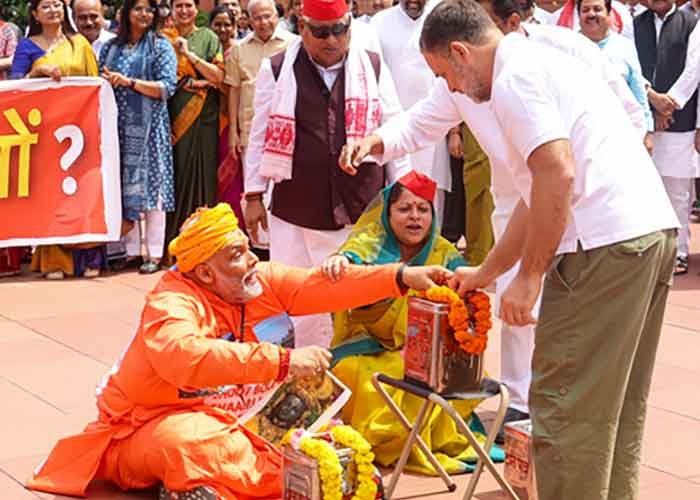
Some recent demonstrations in the Parliament complex illustrated this trend. Independent MP Pappu Yadav appeared in saffron robes in a mock act involving a priest and money, with Rahul Gandhi, Samajwadi Party leaders and others joining him. Congress MP Pawan Khera led a demonstration involving Congress and Samajwadi Party members carrying toy monkeys and raising slogans against Prime Minister Narendra Modi.
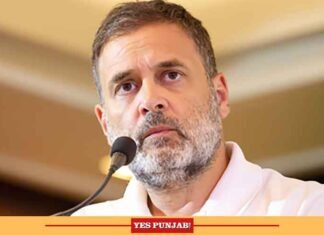
The Congress’ ‘Rachnatmak Congress National Convention’ at Constitution Club on August 13 also attracted controversy after Rahul Gandhi and senior Congress leader Sandeep Dikshit made remarks and gestures concerning Modi and Italian Prime Minister Giorgia Meloni.
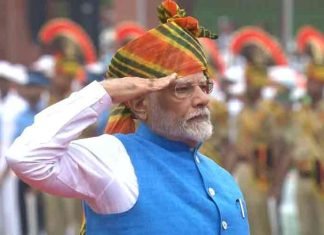
The Independence Day celebrations added another political flashpoint. Congress president Mallikarjun Kharge and Rahul Gandhi stayed away from the main ceremony at the Red Fort for the second consecutive year. The reported disagreement centred on seating, with Rahul Gandhi seeking a front-row position while the government followed the Table of Precedence governing protocol at official functions.
Political disagreement over seating is legitimate. But Independence Day is a national occasion rather than a partisan event, and a boycott can inevitably be viewed as falling short of the symbolism associated with the day.
The controversy over Vande Mataram at the Congress headquarters further intensified the political exchange. Videos from the event appeared to show Kharge and Congress Parliamentary Party chairperson Sonia Gandhi making gestures that were interpreted as asking workers to stop the rendition. Rahul Gandhi also appeared to make a similar gesture moments later.
The Congress denied that Sonia Gandhi had sought to stop the complete rendition. Nevertheless, the visuals triggered a political controversy, with the BJP accusing the Congress leadership of disrespecting the national song.
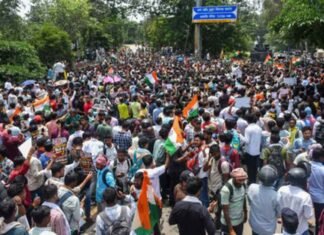
A similar debate surrounds the CJP-led protest at Jantar Mantar. The demonstration, which began around an issue involving students, attracted political groups, NGOs and other supporters. But the attention it generated raises another question: is comparable political energy being shown when students elsewhere face difficulties?
Students in Jharkhand have faced police action, criminal cases and allegations of harassment. In Punjab, the AAP government has denied allegations concerning protesting students, while the Punjab and Haryana High Court has intervened in the matter. Yet the political mobilisation seen around the Jantar Mantar protest has not been equally visible in these states.
None of this diminishes the legitimacy of student grievances. It does, however, raise questions about consistency in political activism and whether causes receive attention based partly on their political usefulness.
The conduct of some CJP leaders has also attracted criticism. Co-convenor Ashutosh Ranka reportedly confronted and threatened a police officer in Rajasthan’s Alwar while invoking the resignation of Union Education Minister Dharmendra Pradhan following the Jantar Mantar protest. Earlier, CJP convenor Abhijeet Dipke was seen shouting at a police sub-inspector assigned to his security detail.
Questions have also been raised publicly about the organisation’s sources of funding. These issues require facts and evidence rather than political insinuation, but they add to the broader debate about standards within contemporary political movements.
The larger issue is therefore not one protest, one party or one gesture. It is the direction in which political culture is moving.
Governments will make mistakes. Opposition parties must challenge them. Political rivals will disagree, sometimes fiercely. That is democracy. But disagreement need not become disrespect, and protest does not have to become performance.
A political movement can attract attention without reducing every issue to a viral clip. Criticism can be uncompromising without becoming abusive. Parliamentary opposition can be disruptive when necessary, but disruption cannot become a substitute for debate.
This matters particularly for younger Indians. Gen Z and Gen Alpha increasingly encounter politics through short videos, memes, reels and social media posts rather than through full parliamentary debates or detailed policy discussions. What remains visible is often the shouting, mockery and confrontation.
If political leaders normalise the idea that shouting is debate, abuse is criticism and disruption is protest, those habits may eventually become embedded in political culture.
Prime Minister Narendra Modi’s reference to “dimagi Naxalism” in his Independence Day address has already triggered a sharp political debate, with the Opposition questioning the phrase and the government offering its own interpretation. Whether the remark was connected to the broader political environment is ultimately a matter for public debate.
What should not be lost in that debate is a simpler principle: politics is ultimately about public issues and public service. When spectacle consistently becomes more important than substance, democracy may remain noisy — but it risks becoming less meaningful.
 FOLLOW NOW