




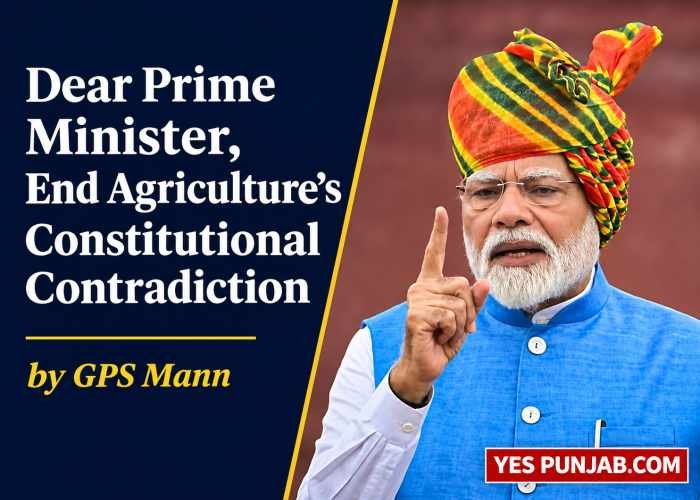
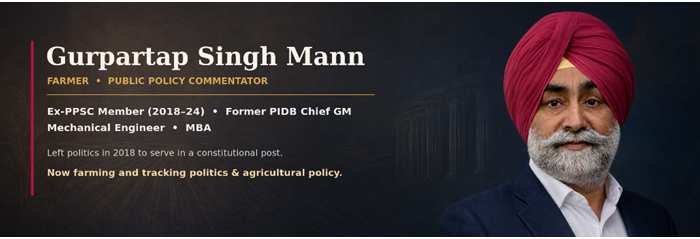
Gurpartap Singh Mann, a farmer and former Member of the Punjab Public Service Commission (PPSC), has written an open letter to the Prime Minister ahead of the proposed parliamentary session on constitutional amendments. His op-ed highlights a fundamental contradiction: agriculture is a State subject, while many powers governing its costs, prices, technology, finance and trade lie with the Union or in the Concurrent List. Mann argues that this imbalance undermines farm profitability and urges the Prime Minister to include agriculture in the constitutional reform agenda.
By Gurpartap Singh Mann
Dear Prime Minister,
As your government considers constitutional amendments concerning delimitation and women’s reservation, I urge you to address another constitutional question affecting roughly 80 crore Indians whose livelihoods are linked to agriculture. Your goal of Viksit Bharat by 2047 requires agriculture to become competitive and profitable. Its constitutional framework deserves examination.
Agriculture is assigned to states, while many decisive powers governing its costs, prices, finance, technology and markets lie with the Union or in the Concurrent List. Central legislation and national policies give the Union the stronger economic role. The farmer grows under one administrative framework but earns under another.
Entry 14 of List II, the State List, begins with “Agriculture, including agricultural education and research”. For a farmer, cultivation, preparation and marketing form one enterprise. Yet the powers governing that enterprise are divided, leaving states without authority over many conditions determining whether cultivation will pay.
The Union List makes this division, and its practical contradiction, visible:
| Entry in List I — Union List | Constitutional wording |
|---|---|
| 38 | “Reserve Bank of India.” |
| 41 | “Trade and commerce with foreign countries; import and export across customs frontiers; definition of customs frontiers.” |
| 42 | “Inter-State trade and commerce.” |
| 45 | “Banking.” |
| 47 | “Insurance.” |
| 48 | “Stock exchanges and futures markets.” |
These powers reach directly into farm economics: credit, insurance, price discovery, interstate sales and access to foreign buyers. A state responsible for agricultural development cannot independently decide these matters.
The Concurrent List carries further decisive powers. Entry 33 covers “Trade and commerce in, and the production, supply and distribution of” specified commodities, including foodstuffs, edible oilseeds and oils, fodder, raw cotton and raw jute. The Third Amendment of 1954 expanded this entry. Entry 34 provides for “Price control.”
In practice, the Union exercises the dominant control over these economic levers through central laws, national policies and commodity orders. The label ‘concurrent’ does not give states an equal say over the decisions that determine farm profitability.
State List Entries 26 and 27, concerning internal trade and the production, supply and distribution of goods, are expressly “subject to the provisions of entry 33 of List III”. For the commodities covered, states’ economic authority is qualified within their own list.
Article 254 reinforces parliamentary priority when valid Union and state laws conflict in the concurrent field. Presidential assent can allow a conflicting state law to operate within that state, but Parliament can subsequently override it. Concurrent jurisdiction therefore gives the Union a clear legislative advantage.
States retain important powers over land and local markets, including Entry 28. Nevertheless, responsibility for agricultural development rests with states while much of the authority determining its commercial success operates at the Centre. This is the constitutional imbalance requiring reform.
The Union fixes national minimum support prices after considering recommendations from the Commission for Agricultural Costs and Prices (CACP) and states’ views. CACP also considers consumer interests and the wider economy. Central fertiliser pricing and subsidy policies affect input costs; central biosafety approvals govern access to GM crop technology. Under Section 45ZA of the RBI Act, the Central Government, in consultation with the Reserve Bank, determines the inflation target.
A state may encourage diversification, only for a central import concession or export restriction to change the crop’s returns. Farmers can produce more without earning more. The cultivation costs, loan and commercial loss remain with the grower.
The Essential Commodities Act, 1955, demonstrates the reach of these controls. Section 3(2)(c) authorises orders “for controlling the price at which any essential commodity may be bought or sold”. Section 3(2)(d) permits regulation through licences, permits or otherwise of “storage, transport, distribution” and other dealings. These powers govern the commercial life of produce after cultivation.
The First Amendment of 1951 introduced Articles 31A and 31B and created the Ninth Schedule, initially listing thirteen agrarian enactments. Article 31B protected listed laws even where a provision was “inconsistent with, or takes away or abridges any of the rights” conferred by Part III. The Essential Commodities Act was added to the Schedule.
Its expansion far beyond land reform has led critics to call the Ninth Schedule a “constitutional dustbin”: a place where governments seek to shelter controversial laws from fundamental-rights challenges.
The Supreme Court subsequently subjected Ninth Schedule insertions made on or after 24 April 1973 to basic-structure review. Review the continuing shield for restrictions on agricultural enterprise while preserving settled land reforms and tenants’ rights.
The National Food Security Act, 2013, illustrates the same division. Reading Article 246(2) with Concurrent List Entry 33(b) explains Parliament’s authority over its foodgrain supply and distribution provisions. Section 2(10) defines MSP as the “assured price announced by the Central Government”. Section 22 assigns the Union procurement and allocation responsibilities.
Food subsidy meets the gap between the economic cost of grain and its issue price. A 2022 parliamentary committee report records an Expenditure Management Commission recommendation to moderate MSP increases to reduce food subsidy. This exposes the tension between containing public expenditure and improving farm returns.
I support free or affordable food for the poor. Its cost must be borne transparently by the public budget. When trade or price controls suppress farmers’ returns, growers shoulder a national welfare burden. Section 31, read with Schedule III(1)(c) of the NFSA, itself recognises farmers’ livelihood security through “remunerative prices”. That commitment deserves equal weight.
Prime Minister, this constitutional division helps explain why, nearly eight decades after Independence, agriculture still lacks a coherent, dependable economic framework. In my assessment, the policy documents of 2000 and 2007 were sketchy and failed to serve the purpose of an integrated agricultural policy. Neither resolved the imbalance, ambiguity and contradiction between responsibility for agriculture and authority over its economics. They consequently failed to provide the framework needed for farmers’ welfare.
Most importantly, announcements about production cannot constitute a comprehensive policy when decisions on inputs, technology, trade, finance and prices pull in different directions.
As you pursue constitutional amendments concerning delimitation and women’s reservation, I urge you to include agriculture in the same reform agenda. Amend the Constitution to recognise agriculture as an integrated economic enterprise and match responsibility with authority. Reconcile State List Entry 14 and Entries 26–28 with Concurrent List Entries 33 and 34 and the relevant Union powers. Clearly assign accountability for the consequences of these decisions for farm incomes, costs and financial viability.
Protect farmers’ economic freedom across cultivation, preparation and marketing, with effective constitutional remedies against unreasonable restrictions. Establish a national agricultural framework that binds the concerned ministries and gives producing states an effective role. A Seventh Schedule amendment requires ratification by at least half the states under Article 368(2); build that agreement around farmers’ freedom to prosper.
Please include agriculture in the constitutional reform agenda. Farmers must be able to benefit from their hard work and successful production. Their prosperity is essential to Viksit Bharat by 2047.
Yours sincerely,
Gurpartap Singh Mann
Feedback mann.gurpartap@gmail.com
About the author:
His father, S. Bhupinder Singh Mann, is a former Rajya Sabha MP, prominent farmer leader and founder of the Bharti Kisan Union and the All India Kisan Coordination Committee.
 FOLLOW NOW