


Bengaluru, November 14 (Yes Punjab News)
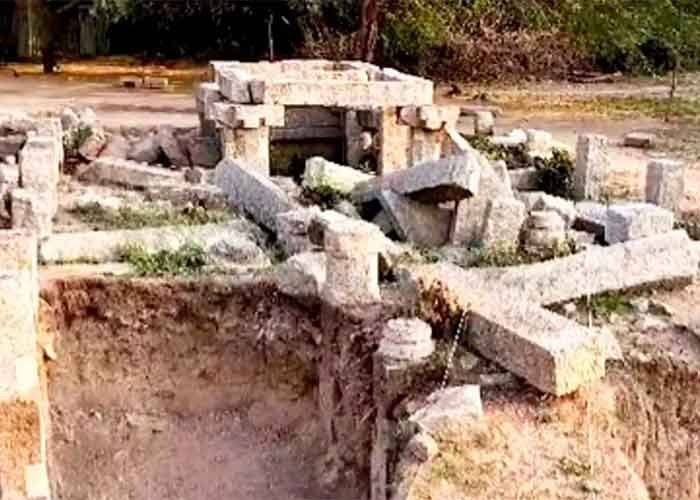
The Archaeological Survey of India (ASI) has unearthed the structural remains of two ancient temples dedicated to Lord Vishnu and Lord Shiva during ongoing excavations near the historic Jain Temple complex at Hampi in Karnataka.
According to the ASI, the discoveries provide insights into regional planning, settlement patterns, and the religious and cultural life of the Vijayanagara Empire. The excavation also yielded several sculptural remains and architectural elements.
The Vishnu shrine is a partially subterranean dwikuta (two-shrined) temple complex built in the classic Vijayanagara architectural style. Constructed using massive dressed granite slabs in dry-stone masonry, its surviving features include a garbhagriha (sanctum), a sunken entrance corridor (ardhamandapa), a decorative moulded basement (adhishthana), lime flooring, heavy supporting beams and stone seating platforms.
High-relief dvarapala (guardian) figures flank the entrance at the base of the door jambs. Although the brick-built shikhara (vimana) has not survived, the foundational walls, stone lintels and door jambs remain largely intact.
Sculptural finds include a headless kneeling winged figure resembling Garuda, relief carvings of Nagadevi and Nagadeva, two sculptures depicting intertwined serpents, and a standing stone image of Lord Vishnu (Sthanaka Murti).
Alongside the Vishnu shrine, archaeologists exposed the foundations of a granite Shiva temple featuring a raised, moulded plinth and a central interior chamber. Pillars at the site also carry prominent sculptural motifs, including Varaha, the sacred boar incarnation of Lord Vishnu.
The excavation site is located near the Ganagitti Temple, regarded as the oldest Jain shrine at Hampi and dating to 1386 AD. It was built during the reign of Vijayanagara ruler Bukkaraya II by his minister Iruguppa Dandanayaka, also known as Iruga.
Dedicated to Lord Kunthunatha, the 17th Tirthankara of Jainism, the temple is an important part of Hampi’s religious heritage.
 FOLLOW NOW