


New Delhi, November 12, 2026 (Yes Punjab News)
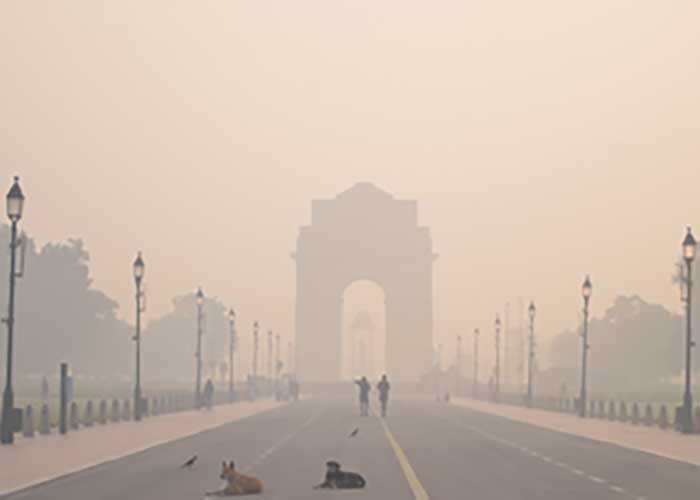
Delhi’s brief spell of improved air quality has ended, with the national capital’s overall Air Quality Index (AQI) rising to 319 on Thursday, pushing pollution levels back into the ‘very poor’ category.
Several monitoring stations across the city recorded particularly high pollution levels. Pusa and NSIT Dwarka topped the list with an AQI of 388 each, followed by Chandni Chowk at 387, Jawaharlal Nehru University (JNU) at 380, Punjabi Bagh at 373 and Chhawla at 369.
Aya Nagar and CRRI Mathura Road recorded an AQI of 366 each, while Talkatora Garden registered 365. Jahangirpuri reported 342, Wazirpur 336, Ghummanhera 334 and Tikri Kalan 322.
Other locations also remained affected, with Anand Vihar recording 319, Ashok Vihar and Bawana 316 each, Sonia Vihar 298, Nangloi 297, Maidan Garhi 290, Karala 258 and Ghoga 232.
Pollution continued to affect the wider National Capital Region (NCR), with Gurugram recording an AQI of 300, Noida 284, Ghaziabad 280 and Faridabad 270.
Weather conditions are unlikely to offer significant relief over the coming days. The maximum temperature in Delhi is expected to remain between 27 and 30 degrees Celsius, while minimum temperatures are likely to range from 14 to 17 degrees Celsius until November 15.
The India Meteorological Department (IMD) has forecast no rainfall in the capital between November 10 and 15. Although a Western Disturbance is approaching, no major temperature change is expected.
Delhi’s pollution problem had intensified even before Diwali. According to an analysis by the Centre for Science and Environment (CSE), the average PM2.5 concentration during the week preceding the festival stood at 236 micrograms per cubic metre — the highest for the corresponding period in three years. This was 97 per cent higher than the 120 micrograms recorded in 2025 and 32 per cent above the 179 micrograms reported in 2024.
Pollution worsened around Diwali, with the city’s average AQI reaching 376 on November 8, compared with 345 on Diwali in 2025. It subsequently stood at 344 on November 9, 299 on November 10 and 313 on November 11, according to reported Central Pollution Control Board (CPCB) figures.
 FOLLOW NOW