
Washington, D.C., July 16, 2026 (Yes Punjab News)
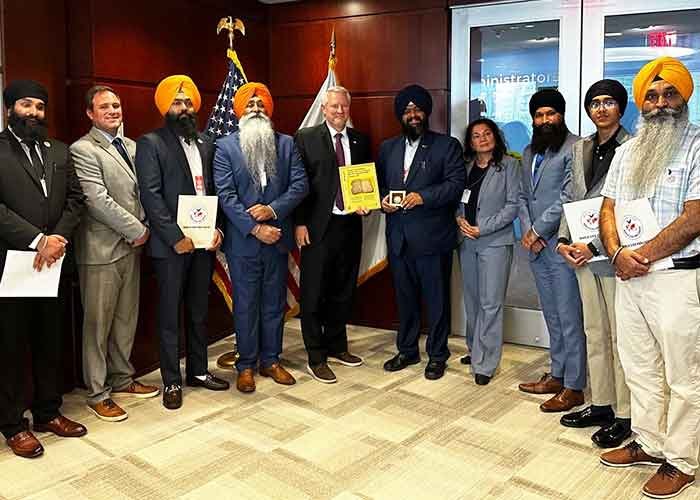
UNITED SIKHS, along with Sikh community leaders and transportation stakeholders, has urged the Federal Motor Carrier Safety Administration (FMCSA) to address concerns arising from the implementation of the agency’s 2026 Commercial Driver’s License (CDL) regulations, saying the new framework has adversely affected thousands of legally present immigrant commercial drivers across the United States.
The concerns were raised during a meeting held on July 9 with senior FMCSA officials, including Ryan M. Snyder, Director of Government Affairs, and Phillip W. Thomas, Deputy Assistant Administrator for the Office of Safety. The discussions centred on the implementation of the FMCSA’s Final Rule titled “Restoring Integrity to the Issuance of Non-Domiciled Commercial Driver’s Licenses (CDLs).”
Sikh Community’s Contribution Highlighted
The meeting began with an acknowledgement of the Sikh community’s longstanding contribution to the American trucking and transportation industry. Participants highlighted the role of Sikh commercial drivers, owner-operators and small trucking businesses in strengthening the United States’ supply chain over several decades.
Community representatives also outlined the historical migration of Sikhs from Punjab, India, beginning in the late nineteenth century and later following the 1984 persecution of Sikhs in India, many of whom established livelihoods in the U.S. transportation sector.
Thousands of Drivers Allegedly Affected
UNITED SIKHS and other stakeholders informed FMCSA that implementation of the new rule, which became legally effective on March 16, 2026, has left thousands of legally present immigrant drivers unable to obtain or renew their commercial driving licences.
According to the delegation, even before the final rule came into force, several state Departments of Motor Vehicles (DMVs) began cancelling or confiscating commercial licences following an interim FMCSA rule issued in September 2025.
The organization said many drivers, despite maintaining excellent safety records for years, suddenly lost their ability to work without sufficient notice, individualized review or an opportunity to demonstrate their lawful immigration status and licensing eligibility.
The delegation argued that highway safety should be determined by measurable driving performance rather than immigration status.
Wider Economic Impact
Stakeholders also warned that the consequences of the rule extend beyond individual drivers and could adversely affect the wider economy.
They maintained that shrinking the pool of qualified commercial drivers may disrupt supply chains, increase freight and transportation costs, raise insurance expenses, place financial pressure on owner-operators and small trucking companies, and increase lending risks for commercial vehicle financiers.
Call Against Anti-Immigrant Narratives
The Sikh delegation urged FMCSA to publicly reject narratives suggesting that immigrant commercial drivers pose greater highway safety risks solely because of their immigration status or background.
They requested the federal agency to reaffirm that driver safety assessments should remain based on objective performance data and measurable safety standards rather than ethnicity, nationality or immigration status.
English Language Enforcement Discussed
The meeting also addressed concerns over enforcement of English language requirements for commercial drivers.
Stakeholders acknowledged that federal law requires drivers to understand traffic signs, communicate with law enforcement officers and complete official documentation. However, they emphasized that regulations do not require native-level English proficiency.
They expressed apprehension that subjective roadside language assessments by inspectors lacking standardized training could result in inconsistent enforcement and duplicate evaluations already conducted during CDL testing by state licensing authorities.
FMCSA officials reportedly responded that they had not observed widespread evidence of such inconsistencies and stated that procedural safeguards already exist within the enforcement system.
Continued Engagement Agreed
The meeting concluded with both sides agreeing to continue discussions. FMCSA officials acknowledged the concerns presented, while UNITED SIKHS committed to submitting additional documentation and recommendations supporting its position.
Follow-Up Letter Highlights State-Level Inconsistencies
In a follow-up communication sent to FMCSA on July 13, UNITED SIKHS highlighted what it described as inconsistent implementation of federal CDL regulations by various states.
The organization cited California’s Department of Motor Vehicles as an example, alleging that it does not accept certain USCIS Form I-797 Notices of Action, which extend the validity of Permanent Resident Cards, as proof of lawful presence for CDL issuance or renewal.
According to UNITED SIKHS, differing interpretations by state licensing agencies undermine FMCSA’s objective of maintaining a uniform nationwide CDL framework and may prevent otherwise eligible lawful permanent residents from obtaining or renewing commercial licences.
The organization urged FMCSA to issue clear written guidance specifying which immigration documents state licensing agencies must accept.
Federal Preemption Sought
UNITED SIKHS also expressed concern over varying state legislation and local policies governing CDL eligibility.
It requested FMCSA to exercise its federal authority by clarifying that commercial driver licensing is governed by a uniform federal regulatory framework and that conflicting state or local provisions should be pre-empted wherever applicable.
According to the organization, such clarification would reduce regulatory uncertainty and strengthen interstate commerce.
Due Process Safeguards Requested
The organization further called upon FMCSA to adopt uniform due process protections before cancelling or revoking commercial driving licences in future cases.
It argued that individualized review of each case would better balance highway safety objectives with fairness and administrative consistency across states.
Recommendations Submitted to FMCSA
In its written submissions, UNITED SIKHS recommended that FMCSA:
- Suspend CDL cancellations affecting drivers holding valid licences issued before March 16, 2026, until individualized due process reviews are completed.
- Clarify acceptable immigration documentation and direct State Driver Licensing Agencies to recognize valid USCIS documents, including qualifying Form I-797 Notices of Action, as proof of lawful presence.
- Conduct a transparent, evidence-based assessment of the workforce, economic and highway safety impact of the 2026 CDL regulations before expanding implementation.
- Establish uniform nationwide procedures governing CDL eligibility.
- Exercise federal authority where necessary to prevent inconsistent state and local CDL standards.
- Publicly reaffirm that FMCSA’s highway safety policies are based on objective performance indicators and that there is no empirical evidence linking immigration status or national origin to increased highway safety risks.
 FOLLOW NOW