
United Nations, September 27, 2026 (Yes Punjab News)
World leaders at the United Nations General Assembly have called for a stronger focus on diplomacy, mediation and conflict prevention, warning that the international system cannot remain focused on responding to wars and humanitarian disasters after they have already caused widespread suffering.
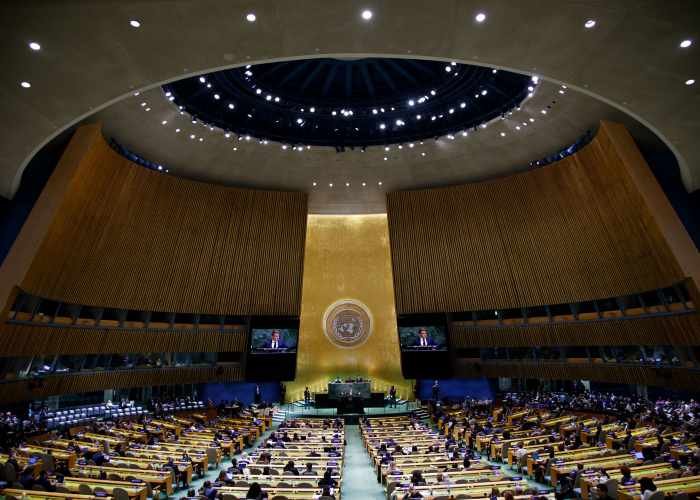
The message featured prominently during the 81st UN General Assembly debate, which is being held amid multiple conflicts and growing geopolitical tensions. The UN’s high-level week has placed peace, international security and the effectiveness of multilateral institutions at the centre of discussions.
Malaysian Foreign Minister Mohamad Hasan delivered a pointed assessment, saying the UN too often responds only after a disaster has occurred, when the focus shifts to counting casualties and delivering humanitarian supplies.
Hasan called for a move “from reaction to prevention”, citing Gaza as an urgent example. Malaysia argued that effective prevention would require stronger institutions, early diplomacy and greater attention to the political circumstances underlying repeated violence.
Rwanda raised a similar concern over the conflict in eastern Democratic Republic of the Congo. Prime Minister Justin Nsengiyumva said the roots of the conflict were political, pointing to longstanding grievances, exclusion and governance failures. He argued that the solution must therefore also be political and backed diplomatic initiatives aimed at resolving the crisis. His assessment of the conflict’s political roots was also reflected in his UN General Assembly address.
The Democratic Republic of the Congo presented a contrasting account, accusing Rwanda of waging a war of aggression through the AFC/M23 armed movement. Prime Minister Judith Suminwa Tuluka said the priority should be implementing peace commitments already adopted rather than creating new texts.
Gambia Vice President Muhammed Jallow said multilateralism did not require countries to agree on every issue. He stressed the importance of remaining at the negotiating table, listening, compromising and continuing dialogue despite differences.
Finnish President Alexander Stubb called for renewed adherence to international law and greater investment in conflict prevention, human rights and sustainable economies. Swiss President Guy Parmelin similarly argued that dialogue should continue even when governments hold opposing positions, saying it was not a sign of weakness.
Dominica President Sylvanie Burton said the UN should be judged not only by how it responds after people suffer, but also by its ability to help countries prevent such suffering.
The UN Charter places peaceful settlement of disputes at the heart of the international system, including negotiation, mediation, arbitration and other peaceful means. The UN can also deploy envoys, peacekeeping missions, sanctions and humanitarian operations under mandates approved by member states. The UN General Assembly has separately stressed mediation and conflict prevention as core tools of multilateral diplomacy.
The debate comes as the 81st General Assembly meets under the theme “Restoring trust, managing transformation: a United Nations that delivers for all”, with conflicts and international security among the central issues facing member states.
 FOLLOW NOW