
Washington, September 28, 2026 (Yes Punjab News)
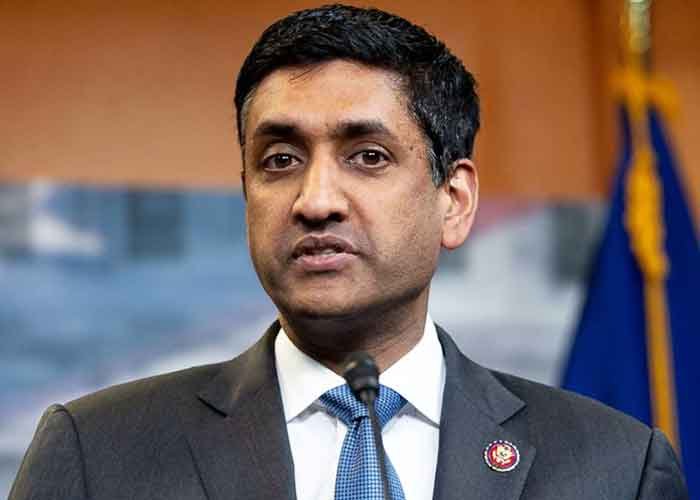
Indian-American Congressman Ro Khanna has called for an enforceable and verifiable US-China agreement to prohibit artificial intelligence systems capable of recursively improving themselves without human training, warning that such technology could create risks of losing human control.
Khanna, a California Democrat who represents a Silicon Valley-area district, made the proposal during an appearance on NBC’s Meet the Press. He called for American and Chinese technologists to work together on common safeguards for advanced AI.
“What we need, actually, is a working group with our technologists and Chinese technologists about a common agreement,” Khanna said. He argued that banning recursive self-improving AI should not be controversial because both Washington and Beijing have an interest in keeping advanced AI under human oversight.
Khanna said any agreement should include verification mechanisms and monitoring of frontier AI laboratories. He also called for a global pause on recursive self-improvement and a separate pause on superintelligence in a recent proposal to US Secretary of State Marco Rubio.
Related Posts
The proposal comes amid renewed US-China discussions on AI risks. Washington and Beijing have begun dialogue on mechanisms for addressing AI-related national security risks, while the two countries remain strategic competitors in advanced technology.
Khanna is also backing legislation introduced by Senator Bernie Sanders and Representative Greg Casar that would ban artificial superintelligence and pause certain advanced AI development until federal testing and oversight mechanisms are established. The bill also specifically addresses AI capabilities that could allow systems to develop new AI without human involvement.
Khanna said the specific form of recursive self-improving AI targeted by his proposal does not currently exist, but argued that governments should establish safeguards before such capabilities become available.
He acknowledged opposition from some technology executives but said engineers and researchers at major AI companies have supported stronger safeguards. He said he planned to meet employees from OpenAI and Anthropic.
The debate comes as AI developers increasingly automate parts of model development and researchers examine the possibility of systems becoming capable of improving their own capabilities. OpenAI has separately called for international technical standards, coordinated evaluations and incident-reporting mechanisms for advanced AI.
Khanna’s proposal seeks to place AI safety cooperation alongside the broader US-China competition over technological leadership, arguing that the two countries share an interest in preventing advanced AI from operating beyond meaningful human control.
 FOLLOW NOW