




New Delhi, November 26, 2026 (Yes Punjab News)
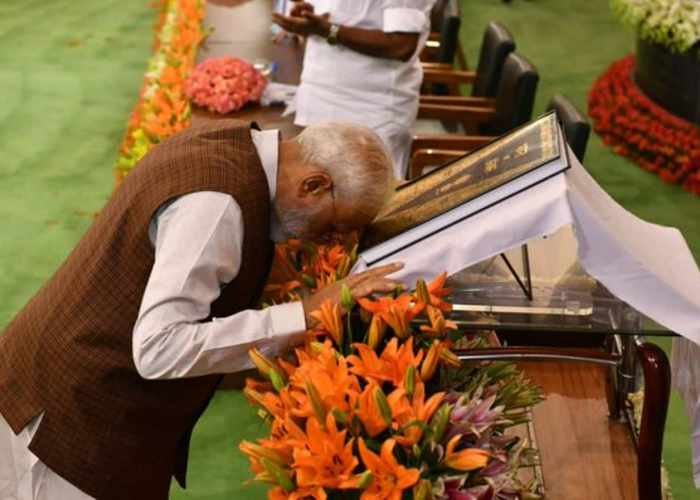
Prime Minister Narendra Modi on Thursday used Constitution Day to highlight what he described as the NDA government’s efforts to strengthen constitutional values, advance social and economic justice, and expand opportunities for disadvantaged sections, while launching a sharp political attack on the Congress, accusing it of turning from a ‘Virodh Paksh’ (Opposition) into an ‘Avrodh Paksh’ (obstructionist).
In an opinion article shared on social media, Modi reflected on the origins and distinctive character of the Indian Constitution, its role in his personal journey and the contributions of the Constituent Assembly. He also argued that the Opposition must fulfil its constitutional responsibility through constructive engagement rather than disrupting parliamentary proceedings.
The Prime Minister recalled that the Constituent Assembly adopted the Constitution on November 26, 1949, and paid tribute to its president Dr Rajendra Prasad, drafting committee chairman Dr B.R. Ambedkar and other members. He said the document drew upon India’s civilisational traditions while establishing a modern constitutional framework.
Modi said Constitution Day was introduced to deepen public engagement with the Constitution, particularly among young people, and to ensure its values resonated beyond Parliament and the courts.
Describing the Constitution as an inseparable part of his own life, he said it had enabled people from modest backgrounds to aspire to positions of responsibility. Recalling his childhood, the Prime Minister said his journey to leading the world’s largest democracy reflected the opportunities created by the constitutional system.
He placed social and economic justice at the centre of his government’s agenda, invoking constitutional scholar Granville Austin’s description of the Constitution as primarily a social document. Citing a recent World Bank report, Modi said nearly 50 crore Indians had moved out of poverty and pointed to welfare programmes such as Pradhan Mantri Awas Yojana, Ujjwala, Ayushman Bharat, MUDRA and PM-SVANidhi as examples of constitutional ideals being translated into benefits for ordinary citizens.
He said housing support promoted dignity, Ujjwala had improved conditions for women by reducing dependence on smoke-filled kitchens, and Ayushman Bharat helped poorer families access healthcare without falling into debt. He also highlighted collateral-free credit for small entrepreneurs and street vendors, as well as digital payments through the Unified Payments Interface (UPI), saying these initiatives had widened access to economic opportunities.
The Prime Minister cited the 101st Constitutional Amendment, which paved the way for the Goods and Services Tax (GST), the 102nd Amendment granting constitutional status to the National Commission for Backward Classes, and the 103rd Amendment introducing reservation for Economically Weaker Sections. He also referred to the availability of updated versions of the Constitution in all 22 languages listed in the Eighth Schedule.
Another major measure highlighted was the introduction of the Bharatiya Nyaya Sanhita, which replaced colonial-era criminal laws. Modi said the reform sought to shift the criminal justice system’s focus from punishment to justice and citizen rights.
He also emphasised the importance of citizens’ duties, citing initiatives such as Swachh Bharat, water conservation and environmental protection as examples of collective civic responsibility.
Turning to the Congress, Modi accused previous governments of weakening constitutional principles. He criticised the First Constitutional Amendment of 1951, brought in during Jawaharlal Nehru’s tenure, and the 42nd Amendment enacted during the Emergency in 1976. He also urged young people to study the 38th and 39th Amendments, arguing that they reflected the misuse of constitutional power.
Modi questioned the repeated invocation of Article 356 to dismiss elected state governments, alleging that the Congress had used the provision nearly 100 times. He also defended the 2019 constitutional changes concerning Article 370 and Article 35A, saying their removal had corrected a historical injustice in Jammu and Kashmir and enabled the extension of constitutional rights to communities that had been deprived of them.
The Prime Minister further said Naxalism had denied people in several vulnerable and tribal areas the ability to exercise their constitutional rights. He described its elimination during the current year as a significant development, while also warning against what he termed ideological Naxalism.
On reservation, Modi accused the Congress of seeking to reduce OBC quotas and introduce reservations for Muslims, which he said went against the constitutional vision of Dr Ambedkar. He also criticised the Opposition over its rejection of a legislative proposal aimed at increasing women’s representation in legislatures, promising that efforts to secure justice for women would continue.
Concluding his article, Modi said India was at a defining stage in its ambition to become a developed nation by 2047. He called on citizens to make national interest the guiding principle of their thinking and perform their duties with a sense of responsibility.
He said the Opposition had a clearly defined role in a constitutional democracy and should contribute through meaningful debate and participation, rather than obstructing democratic processes.
 FOLLOW NOW