

New Delhi, October 13, 2026 (Yes Punjab News)
Canadian High Commissioner to India Christopher Cooter on Tuesday praised India’s economic growth and credited Prime Minister Narendra Modi’s leadership with giving the country a direction it did not have before.
In an exclusive interview with IANS, Cooter said it was exciting for Canada to witness India’s progress under Modi’s leadership. His remarks came in response to a question about the Prime Minister completing 25 years in public service, including his tenure as Gujarat Chief Minister and his years as Prime Minister.
“Congratulations to your Prime Minister. That’s a lot of public service in very senior positions as the Chief Minister of Gujarat and then the Prime Minister. I think that the Prime Minister Modi has given India direction it did not have before. My first posting here was 25 years ago. India was beginning to be on the move, but there was still the ‘License Raj’. I think what I hear from the Prime Minister, from ministers here is a commitment to move your country even faster. You’re growing at 7.8 per cent,” Cooter told IANS.
Referring to discussions about India’s future economic ambitions, Cooter said recent remarks by the Union Commerce Minister and Andhra Pradesh Chief Minister N. Chandrababu Naidu about the possibility of achieving 15 per cent growth were particularly noteworthy.
“Yesterday, your Commerce minister and Chief Minister Naidu (Andhra Pradesh Chief Minister N Chandrababu Naidu) talked about growing to 15 per cent and that would almost be a doubling at least for some states. I mean, this is very interesting for us and to have a partnership which is going in a very positive direction with a country whose Prime Minister is so committed both to expanding the bilateral relationship, but also to growing an India which has never been seen before in the world, we don’t have anything like this in history,” he said.
Cooter described India as a country of unprecedented scale, noting that its democratic system and future growth presented significant opportunities for international partnerships.
“This is a very exciting time for us to watch what’s going on in India under the direction of your Prime Minister. So again, congratulations, not only to the Prime Minister, but also to what India has achieved over the last couple of decades,” he added.
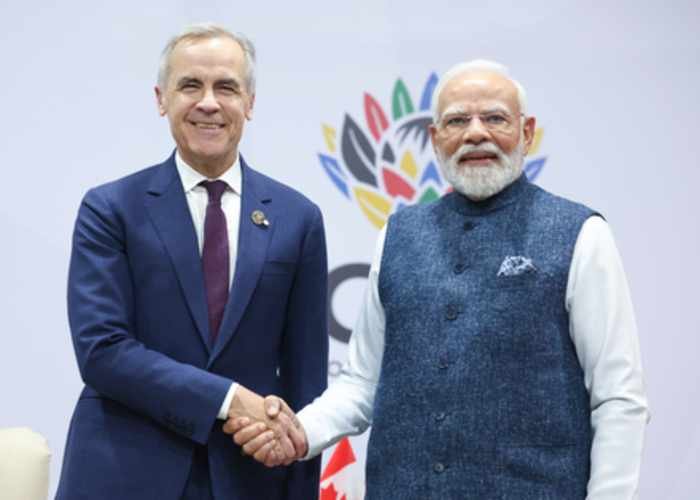
The Canadian envoy also expressed confidence that Prime Minister Modi would visit Canada in December, ahead of the G20 meeting scheduled to take place in the United States, and hold talks with Canadian Prime Minister Mark Carney.
“I think that visit will happen. I’m pretty confident that they will meet. It’s going to be before probably the G20 meeting, which takes place this year in the US. So, as I said, there are so many things happening in the relationship. They’ll have lots to talk about. And, I think they’re going to have a number of things to sign or witness, such as the Free Trade Agreement. But we have a number of other agreements, major agreements, that are in the works,” Cooter said.
He added that the two leaders would also discuss international developments, including the continuing conflict in West Asia and climate-related challenges.
The High Commissioner said both countries had growing reasons to strengthen their partnership amid changes in the international political and economic order.
“We just find we have more and more to talk about in a world which is characterised, as our Prime Minister said, by a kind of rupture in the system that we used to rely on. That rupture is on the trade side, it’s on the political side. We find that in that rupture, we are both democracies, we’re both in the Commonwealth, we have similar systems, we have a huge link because of the diaspora in Canada, some two million people, and we just find there’s more and more to talk about together,” he said.
Modi and Carney last met on the sidelines of the G7 Summit in Evian, France, in June. During the meeting, the two Prime Ministers welcomed the positive momentum in India-Canada relations and noted progress made since Carney’s visit to India in March 2026. They also reaffirmed their commitment to building a forward-looking strategic partnership.
Cooter also discussed the October 6 meeting in New Delhi between National Security Adviser Ajit Doval and David Morrison, the senior diplomatic and international affairs adviser to the Canadian Prime Minister. He said the two countries were exploring cooperation in areas including counter-narcotics, extortion and cybercrime.
“Our cooperation goes beyond counterterrorism. We had our National Security Advisors speak and we are also looking at counter-narcotics, extortion, criminals. We’re looking not just at the bilateral relationship, but crime is transnational. So cybercrime, for example. We talked about scam centers, those kinds of things that go well beyond our countries, but we’re both facing the pressures that criminals are putting on us because of those things,” Cooter said.
He added that officials were working rapidly to identify ways to cooperate, describing the meeting as another positive development in bilateral engagement. According to him, it was the third meeting in a year involving the countries’ national security advisers and senior officials from their respective agencies.
Addressing the economic impact of the ongoing conflict in West Asia, Cooter said India and Canada could deepen cooperation on fuel and fertilisers to help address supply pressures.
He also highlighted the situation facing Indian nationals in the Gulf, saying the conflict was creating uncertainty for the region and the wider global economy.
“We know it puts a lot of pressure on you, both fertilizer and fuel, as well as the nine million Indian nationals who are in the Gulf. It’s not easy to see how this is going to end soon… Canada can be an option for you. We do have a lot of fuel. We do have a lot of fertiliser. We are the largest producer of potash, for example,” he said.
Cooter added that Canada could help India navigate the difficult period through cooperation that benefits the Indian economy and its people. He also expressed hope that India, working with countries in the region and the United States, would play a central role in efforts to bring the conflict to an end.
 FOLLOW NOW