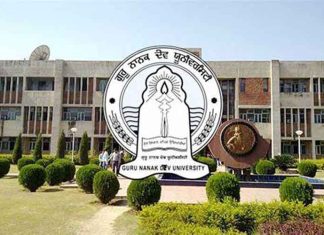

Panjab University (PU) is not just an academic institution; it is a layered cultural, political, and emotional symbol in North India. Established in Lahore in 1882, it carries the rare legacy of surviving the upheaval of Partition, rebuilding itself in Shimla, and finally taking permanent shape in Chandigarh in the late 1950s. For Punjab, PU represents continuity — of ideas, identity, and intellectual life.
For more than a century, the university’s governance relied on its Senate: a democratic body of nearly 90 members, including elected faculty, principals, and the powerful Registered Graduate constituency. This participatory framework cultivated a sense of collective ownership. But the absence of a fully constituted Senate since late 2024 created a leadership vacuum that set the stage for an unprecedented confrontation.
The Central Challenge: Law, Power, and Institutional Control
The crisis escalated in October 2025, when the Central Government, using its powers under Section 72 of the Punjab Reorganisation Act, 1966, issued a notification proposing major structural reforms:
- Reducing the Senate’s size from ~90 members to about 30
- Abolishing the elected Registered Graduate constituency
- Shifting control toward a predominantly nominated administrative body
In its court filings and public statements, the Centre asserted that its authority under the 1966 Act is paramount. It defended the changes as necessary for “administrative efficiency,” citing a High-Level Committee’s findings that the Senate’s elected structure was slow, politicized, and resistant to NEP-2020–aligned modernization.
This argument brought the core conflict into sharp focus: Central authority and administrative reform vs. institutional autonomy and democratic representation.
The Spark: The ‘Affidavit of Silence’
Before the Senate notification, the administration introduced a mandatory “No-Protest Affidavit” for incoming students in 2025–26, requiring them to pledge not to participate in any “disruptive” protests. Students instantly recognized it as an attack on their constitutional right to dissent and dubbed it the “Affidavit of Silence.”
What followed was historic:
- Hunger strikes across the campus
- Support from civil society and media
- Political attention from Punjab leaders
On November 4, 2025, the administration withdrew the affidavit — a rare victory that energized students and laid the psychological foundation for a larger movement. As one student said:
“Jithe affidavit wapas ho sakdi hai, othe notification vi ho sakda hai.”
The PU Bachao Morcha: The Heart of Campus Resistance
If one force transformed the governance dispute into a mass democratic movement, it was the PU Bachao Morcha — a coalition of students, teachers, alumni, cultural groups, and public intellectuals.
A Movement Rooted in History and Punjabiyat
The Morcha viewed the Centre’s notification as more than administrative overreach:
- Diluting Punjab’s historical stake in the university
- Weakening PU’s democratic character
- Attacking the Registered Graduate constituency — the bridge between PU and the Punjabi public
As one volunteer put it:
“Graduate seat nu khatam karna matlab awaaz nu khatam karna.”
Strategic, Disciplined, and Mass-Based
The Morcha was highly organized:
- Daily open forums at the Students’ Centre
- Constitution-reading circles
- Night vigils at the Arts Block
- Legal committees studying the 1966 Act
- Alumni networks mobilising support nationally and internationally
This approach gave the movement credibility and staying power.
Unprecedented Political & Social Unity
The Morcha united all segments of the campus and beyond:
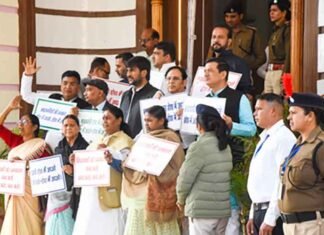
- Students led marches
- Retired professors joined sit-ins
- Alumni — including lawyers, journalists, and artists — issued solidarity statements
- Punjab’s major political parties — AAP, Congress, SAD — publicly supported the movement
What started as a campus issue quickly became a regional constitutional movement.
Clear, Constitutional Demands
The Morcha’s demands were precise:
- Restore the full Senate structure
- Hold immediate Senate elections
- Protect PU’s federal character and Punjab’s representation
Even after the Centre rescinded the notification on November 7, 2025, the Morcha continued daily gatherings. Students remained wary:
“Notification wapas hoyi hai, intention nahi.”
The rollback was seen as temporary unless Senate elections were held to secure PU’s democratic framework permanently.
The Punjab Bachao Morcha: When Campus Became Statewide
The movement quickly evolved into the Punjab Bachao Morcha, connecting PU’s internal crisis to Punjab’s cultural and political identity.
Civil society groups, kisan unions, student bodies, and cultural organisations from across Punjab issued statements warning that the notification threatened federal principles. Protests spread from Chandigarh to Ludhiana, Amritsar, Patiala, Sangrur, Bathinda, and Tarn Taran.
A common slogan resonated:
“Panjab University sirf campus nahi — Punjab da adhikar hai.”
This elevated the issue to a regional constitutional debate, beyond campus politics.
Why Senate Elections Are the Core Issue
PU’s democratic health hinged on the Senate. Without elections:
- Decisions lack legitimacy
- No financial oversight exists
- Executive power faces no check
- Alumni and public have no representation
The absence of the Senate since 2024 created a constitutional vacuum, making the Centre’s restructuring attempts during this period appear as an attack on democracy.
Protesters argued:
“Reform cannot happen in the dark. Senate rehndi hai taan University rehndi hai.”
The Larger Implications
PU’s struggle is not limited to its campus. It raises critical questions about:
- Federalism: Use of Section 72 over a federal institution
- Representation: Reducing public and alumni participation
- Democratic Culture: Silencing dissent threatens academic freedom
- Regional Identity: PU is a symbol of Punjab’s historical and cultural continuity
As an academic observer noted:
“Destroying structures of representation is easy; rebuilding trust takes generations.”
Autonomy, Dissent, and the Centre-State Balance
The Panjab University crisis is more than a governance dispute. From the Affidavit of Silence, to the Senate vacuum, to the PU and Punjab Bachao Morchas, it is a fight for democratic voice, regional identity, and institutional autonomy. PU’s community has shown that the university’s strength lies not in buildings or rules but in the voices that question, dissent, and participate.
Whether 2026 brings elections or further confrontation, PU has already proven its community will defend its history, identity, and democratic soul.
 FOLLOW NOW