

Shahkot (Village Malsian), February 23, 2026 (Yes Punjab News)
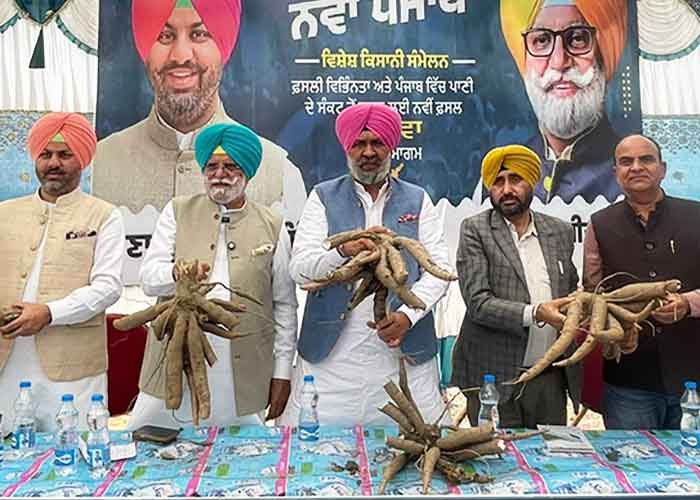
In a significant push towards crop diversification and sustainable agriculture, Kapurthala MLA Rana Gurjeet Singh and Sultanpur Lodhi MLA Rana Inder Partap Singh today visited Malsian village near Shahkot, where they interacted with farmers and encouraged them to adopt Cassava (Manihot esculenta) cultivation as a viable alternative to traditional water-intensive crops.
Addressing a gathering of farmers, Rana Gurjeet Singh emphasized the immediate need to diversify Punjab’s cropping pattern to conserve rapidly depleting groundwater resources. “We have to save our subsoil water, which is receding at the alarming rate of nearly one metre every year,” he said.
Highlighting his past efforts, he added, “I am like a farmer. My role is not only to represent people in the Legislative Assembly and take part in legislative committees, but to work on the ground for their welfare. In 2019, when there was a severe labour shortage, I promoted Direct Seeding of Rice (DSR) with the support of PAU. The technique developed in 2007–08,” Rana Gurjeet Singh informed.
By this way of cultivation we saved 30% water but paddy growers again shifted back to the traditional system of paddy cultivation. We are extracting excess 16 billion cubic feet of groundwater and by doing this we are exhausting Punjab’s precious natural reserve.
Encouraging farmers to explore new crops, Rana Gurjeet Singh pointed out that marketing concerns often discourage diversification. “Whenever we talk about a new crop, farmers immediately ask about marketing and sale. I understand their concerns. That is why I not only promoted monsoon maize but also assured its purchase, and I will continue to stand by that commitment the next year,” he said.
Speaking about cassava’s potential, he described it as a gluten-free, pest-resistant crop requiring minimal care. “Cassava is planted at two-inch depth with 36-inch spacing. Around 5,000 plants can be grown per acre, yielding nearly five kilograms per plant. This translates to an estimated 250 quintals per acre,” he explained.
“The crop needs attention mainly in the first three months and requires just one herbicide spray. After that, farmers are largely free as the crop takes seven to nine months to be harvested,” he further said.
He further stated that cassava grows well in loamy and sandy loamy soils, making it suitable for the Doaba region. “I am confident that hardworking farmers of Doaba will make cassava as successful as they made maize and beetroot.
Maize yields have increased from 20 quintals to nearly 50 quintals per acre, while beetroot cultivation has expanded to around 15,000 acres with yields reaching 500 quintals per acre,” he noted.
On the economic front, Rana Gurjeet Singh underlined the profitability of the crop. “Cassava currently sells at around Rs. 15 per kilogram, ensuring an income of nearly Rs. 2.5 lakh per acre. When marketed properly, rates can cross Rs. 20 per kilogram.
Compared to crops like potato, which often cause financial distress due to price fluctuations, cassava offers stable and higher returns,” he said. He urged at least 20 farmers to begin with one acre each as a pilot initiative.
Reassuring farmers about market linkages, he declared, “If I can support maize, I will support cassava as well. Marketing will not be a problem. It is my responsibility to ensure procurement and processing. The produce must reach factories within 48 hours of harvest for processing into dry powder, and we will facilitate that.”
Rana Inder Partap Singh highlighted cassava’s industrial importance, stating, “Maize contains about 58 per cent starch, rice around 68 per cent, whereas cassava has 70 to 80 per cent starch content. This makes it highly valuable for processing industries.
We have already conducted groundwork and prepared standard operating procedures for its cultivation. Trials conducted last year were beneficial and encouraging, provided best agricultural practices are followed.” The byproduct of Cassava is used in making sabudana (Tapioca Pearls or Soga), used in animal feed industry and other starch producing industries.
He added that leading agricultural institutions, including Indian Council of Agricultural Research (ICAR), are supporting the initiative. Cassava expert Dr. M. Nedunchezhiyan Director ICAR, Bhubaneswar (Odisha) was present during the interaction and shared technical guidance with farmers.
Rana Gurjeet Singh appealed to farmers to join the movement. “Support me in this endeavour. Together, we can conserve water, protect our environment, and significantly enhance farmers’ income. With the Almighty’s blessings, I take full responsibility for supporting you at every step,” he said.
 FOLLOW NOW