
Shimla, Feb 11, 2026
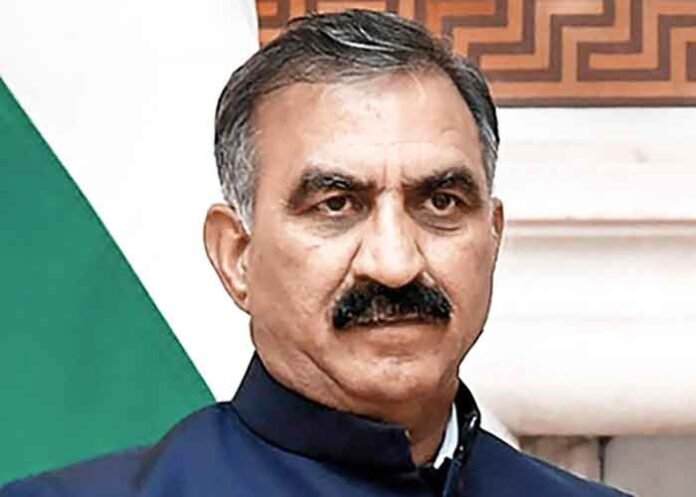
Himachal Pradesh Chief Minister Sukhvinder Singh Sukhu on Wednesday accused the previous BJP government in the state of plundering the coffers and spending lavishly instead of investing in development and infrastructure.
The Chief Minister questioned the BJP’s defence of the 16th Finance Commission’s observations regarding the discontinuation of the Revenue Deficit Grant (RDG), pointing out that the BJP tenure benefited from a whopping Rs 54,296 crore of RDG.
“This grant, which accounted for 25 to 30 per cent of the state’s total revenue receipts along with Rs 16,000 crore in GST (Goods and Services Tax) compensation, is utilised for political stabilisation and freebies rather than addressing the state’s long-term fiscal health,” CM Sukhu told the media here after visiting Delhi.
The Chief Minister detailed a stark contrast in the financial support received by the two administrations, noting that while the BJP received over Rs 54,296 crore across five years, the current government has been provided only Rs 17,563 crore in the past three years, nearly half of the previous allocation.
Detailing, he said the BJP got Rs 8,449 crore in 2018-19 during the 14th Finance Commission as RDG, Rs 8,271 crore in 2019-20, Rs 8,062 crore in 2020-21, besides Rs 11,431 as interim grant, Rs 7,834 crore in 2021-22 and Rs 10,249 crore in 2022-23 by 15th Finance Commission, totalling Rs 54,296 crore.
Whereas, CM Sukhu claimed, the present Congress government just got Rs 8,058 crore in 2023-24 during the 15th Finance commission, Rs 6,258 crore in 2024-25 and Rs 3,257 crore in 2025-26, totalling Rs 17,563 crore, which is almost less than half of the amount the BJP got in the form of RDG. Despite the substantial funds available to them, the BJP government failed to disburse employee arrears or announce dearness allowance (DA).
Furthermore, the Chief Minister highlighted that the previous regime did not invest significantly in health infrastructure, a sector the current government is now prioritising with a Rs 3,000 crore modernisation plan and an additional Rs 1,300 crore under JICA Phase-II to upgrade healthcare delivery systems.
He said the fiscal landscape inherited in December 2022 was described as one defined by a massive accumulation of debt and deferred financial commitments. By the end of the BJP’s term, the state’s total outstanding debt had surged to approximately Rs 76,185 crore, an increase of nearly Rs 28,000 crore in just five years.
This burden was exacerbated by a Rs-10,000 crore liability in revised pay scale arrears and DA, which the Chief Minister labelled a ‘last-minute’ political manoeuvre performed without any budgetary provisions. This ‘opening spree’ of over 900 institutions in the final six months of the BJP tenure created an additional annual unfunded liability of Rs 5,000 crore, forcing the current government to de-notify many of these units to prevent total economic collapse.
Concluding his remarks, CM Sukhu stated the BJP’s current “hue and cry” over the state’s fiscal position is hypocritical given their history of vandalising the state’s treasury.(Agency)








Experts recall UPA’s ‘nuclear concessions’ as Rahul Gandhi alleges ‘sellout’ over India-US trade deal
New Delhi, Feb 11, 2026
Congress MP and Leader of Opposition in Lok Sabha, Rahul Gandhi’s charge that the present government has “sold out Bharat Mata” over a trade and tariff framework with the United States would carry more weight if his own party’s record did not tell a very different story, say political observers.
Before accusing others of compromising national interest, it is worth revisiting what happened in 2008, when the Congress-led UPA government negotiated and signed the Indo–US Civil Nuclear Agreement, often celebrated by them as a historic diplomatic triumph, analysts argue.
The 123 Agreement was projected as a breakthrough that would end India’s so-called “nuclear isolation.” And indeed, it did open doors to global nuclear commerce and secured a waiver from the Nuclear Suppliers Group. But unfortunately, that access came with explicit, binding commitments that reshaped the structure of India’s nuclear programme in ways that critics even today describe as deeply intrusive.
Under the agreement, India was required to submit a formal “Separation Plan”. This was not a symbolic gesture. “India had to divide its nuclear infrastructure into civilian and military streams and place the entire civilian programme under permanent International Atomic Energy Agency (IAEA) safeguards.” Fourteen out of twenty-two power reactors at the time—including future civilian facilities—were brought under inspection “in perpetuity.” In simple terms, a large segment of India’s energy infrastructure was opened to continuous international monitoring.
According to observers, the United States made its expectations clear. In its own statement, it declared: “India has committed to separate its military and civil activities and submit its entire civil program to international inspection.” This was not an interpretation by critics; it was Washington’s official position.
The Hyde Act, a US domestic law that operationalised the deal, required the US President to submit annual compliance reports to the US Congress regarding India’s conduct, say nuclear watchers. Effectively, an aspect of India’s sovereign programme became subject to foreign legislative scrutiny, they add.
By agreeing to perpetual safeguards and restrictions on the transfer of enrichment and reprocessing technologies, India accepted limits that affected its long-term three-stage nuclear vision and closed fuel cycle strategy, experts explain. Moreover, the arrangement was linked to India’s unilateral moratorium on nuclear testing, creating strategic constraints in a volatile regional security environment.
At the time, this was hailed by the UPA as one of its greatest achievements. “Yet today, the same political leadership questions the patriotism of a government negotiating trade terms that are transparent, reciprocal, and subject to parliamentary oversight,” experts argue. According to them, sweeping accusations about “selling out” ring hollow when viewed against history.(Agency)