
by HS Bawa
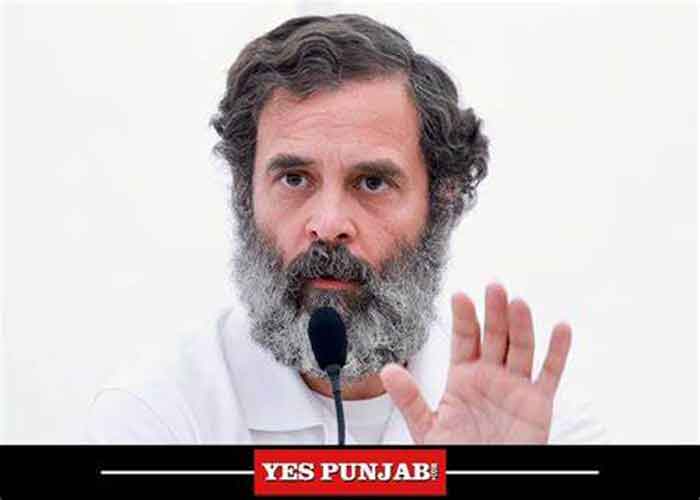
Rahul Gandhi’s address in Barnala was expected to follow a familiar script — criticism of the Narendra Modi government, defence of MGNREGA, and solidarity with farmers under the Congress campaign “Save MGNREGA, Save Farmers.” What unfolded instead was far more politically layered.
Yes, Rahul Gandhi did take on the Centre. He spoke of what he described as compromises in the US–India trade understanding, referred to the potential political implications of the Epstein files on individuals seen as close to the BJP ecosystem, and highlighted President Donald Trump’s assertion that Indo-Pak tensions were diffused through tariff threats — while drawing attention to what he termed an “eerie silence” from the Prime Minister on that claim. These were sharp political interventions. Yet, for all the external fire directed at Washington and New Delhi, the most consequential segment of his nearly 30-minute address was not aimed at the BJP or global power equations. It was aimed inward — at his own party.
And it was unmistakably deliberate.

The Warning That Shifted the Mood
In a deliberate shift during his speech, Rahul pivoted — not in tone, but in direction.
“If anyone does not function as a team player, then Congress president Mallikarjun Kharge and I will take appropriate action.”
Then came the sharper formulation: “A single player cannot win the game. We have an entire team. Be a team player, otherwise we will make you sit in reserves. No matter how big a player you are, no one is bigger than the party.”
The tone was firm. The body language direct. His gestures toward the senior leadership seated in the front row were hard to miss.
The question that followed was immediate: Was this spontaneous frustration? Or calculated messaging?
This Was Strategy — Not Emotion
It did not resemble an emotional outburst.
Two moments reveal why.
First, when Rahul sternly admonished the leadership and warned of consequences regardless of stature, the loudest applause came from the party workers — not the front row. The cheers were spontaneous and emphatic.
Second, immediately after delivering that pointed warning, Rahul shifted his emphasis — from leaders to workers. He declared that party workers are the core strength of the Congress.
That sequencing was politically intelligent.
By publicly disciplining leadership and then elevating the cadre, Rahul inverted the traditional hierarchy of power display. He signaled that legitimacy flows upward from workers — not downward from factional strongmen.
The Message Between the Lines
The subtext was unmistakable.
To workers:
Your hard work will not be sacrificed at the altar of internal rivalries.
To leaders:
Internal score-settling under the banner of “internal democracy” will not be tolerated if it weakens electoral prospects.
Punjab Congress has, for years, wrestled with factionalism. Personal camps have often overshadowed organisational coherence. Internal differences have spilled into the public domain, damaging credibility and electoral performance.
Rahul’s message was therefore not just corrective — it was preventative.
He was not merely warning leaders. He was reassuring workers.
He was telling them: Work hard. Organise. Mobilise. The high command will not allow leadership infighting to undo your efforts.
Why Say It Publicly?
Critics argue such discipline should have been enforced behind closed doors. That public reprimand arms opponents with narrative ammunition.
But political communication is not only about damage control — it is about signalling intent.
Closed-room admonitions do not energise cadres. Public lines drawn in the sand do.
In Barnala, Rahul did something subtle but significant: he placed himself and Mallikarjun Kharge as custodians of organisational discipline, while aligning emotionally with grassroots workers.
The applause he received was not incidental. It was validation.
Beyond Punjab
And here lies the broader significance.
Punjab may have been the stage. But the script felt national.
Across several states, the Congress has struggled with factional pulls and personality clashes. The Barnala intervention could well be a template — a declaration that discipline and collective functioning are now non-negotiable.
If so, this was less about a single state unit and more about organisational recalibration.
It was a message that stature will not shield indiscipline. That electoral viability requires unity. That the party will protect its grassroots from being collateral damage in leadership rivalries.
Rejuvenation or Risk?
There is risk in public correction. It can bruise egos. It can deepen resentment.
But there is also power in clarity.
The workers left Barnala energised. They applauded when discipline was invoked. They responded when their centrality was acknowledged. They heard a promise — implicit but powerful — that their labour would not be nullified by factional games.
Opponents may mock the optics. They may call it humiliation. But politics often turns not on comfort, but on control.
If the message succeeds in curbing factionalism, Barnala may be remembered as a turning point. If it fails, it will be seen as a missed opportunity.
For now, however, one thing is beyond doubt: Rahul Gandhi did not merely address a rally in Punjab. He asserted authority within his party.
And in doing so, he signaled that in the Congress of tomorrow, the choice for leaders may be simple — play as a team, or watch from the sidelines.
editoryespunjab@gmail.com
Jalandhar, February 28, 2026
 FOLLOW NOW