


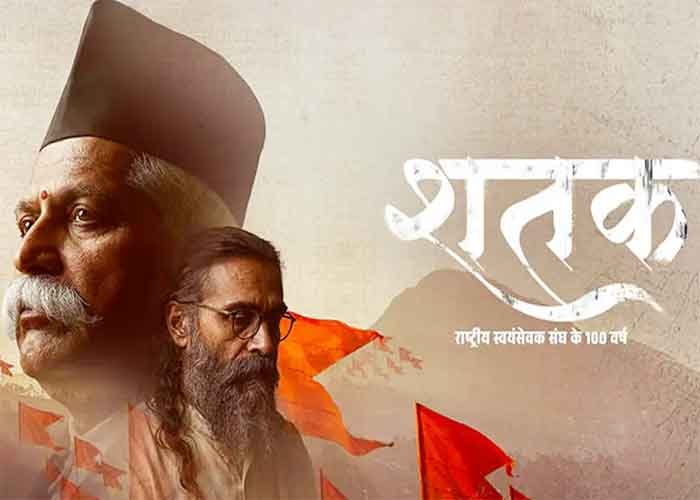
Director: Aashish Mall, Writers: Nitin Sawant, Rohit Gehlot, Utsav Dan, Concept by: Anil Dhanpat Agarwal, Duration: 112 Minutes, Rating: 4.5
A lot has been said, criticized, and debated about the Rashtriya Swayamsevak Sangh over the decades. Shatak does something extraordinary—it transforms discussion into experience, debate into understanding, and history into living, breathing moments.
This film is not just about events; it is about the people, the courage, and the unshakable conviction behind one of India’s most influential movements. Ambitiously, it covers the first 50 years of the RSS, with the promise of the next 50 years still to unfold—a cinematic journey that leaves the audience eagerly anticipating what is yet to come.
From the very first scene, Shatak establishes itself as a masterpiece of historical storytelling. One of India’s pioneering films to blend live-action with the most advanced technology, it uses cutting-edge techniques not as a spectacle but as a seamless bridge to bring historical figures and moments to life with stunning realism.
The film’s depiction of Dr. Keshav Baliram Hedgewar is profoundly moving. Here is a man -India’s forgotten hero whose belief in discipline, character, and service laid the foundation of a century-long mission. Watching his early years, his humble beginnings and the sacrifices he endured during the freedom struggle builds him into not just a founder, but a visionary whose quiet resolve shaped a movement larger than himself.
The simplicity of the early days—the open fields, the small gatherings, the tentative steps of an idea—feels honest, lived-in, and inspiring. These scenes remind us that monumental movements are often born in the humblest of settings, nurtured by dedication rather than spectacle.
As the narrative moves into the leadership of Guruji Madhav Sadasiva Golwalkar, the film’s tone deepens, capturing moments of introspection, tension, and resilience.
The film uncovers and builds perspectives to the multiple bans on RSS during the freedom struggle and then following Mahatma Gandhi’s assassination is portrayed with quiet gravitas rather than melodrama.
The rebuilding of the organization during this period, depicted with patient attention to detail, showcases strategic foresight, moral courage, and unwavering commitment. The film allows these chapters to breathe, giving the audience a chance to truly grasp the scale and significance of the challenges faced.
Shatak is not only about organizational history—it is about India’s nation-building moments. The liberation of Dadra and Nagar Haveli is depicted with restraint and dignity, a quiet but powerful celebration of freedom.
The efforts to secure Kashmir and the guidance provided in turbulent times are handled with sensitivity and precision, reminding viewers that the RSS played a significant role behind the scenes in shaping India’s destiny. These sequences are a testament to courage, vision, and the spirit of service, portrayed in a way that resonates long after the screen goes dark.
What makes Shatak remarkable is its focus on human stories within history.
Young swayamsevaks leaving home, families facing uncertainty, volunteers quietly taking on enormous responsibility—the film captures their emotions, fears, and steadfast dedication. Each frame lingers just enough for the audience to feel the weight of commitment and the nobility of purpose, making history deeply personal and profoundly moving.
The team behind Shatak deserves boundless praise. Conceptualized by Anil D. Agarwal, directed with nuance and care by Aashish Mall, and produced by Vir Kapur with co-producer Aashish Tiwari under Ada 360 Degree LLP, the film is a labor of passion, integrity, and belief. Every creative choice reflects respect for history, the organization, and the people whose stories are being told. The filmmakers could have gone for sensationalism—but instead, they embraced authenticity, subtlety, and depth.
Shatak is not just a historical recounting; it is an emotional, eye-opening exploration of conviction, courage, and service. It transforms debates about the RSS into understanding and empathy, showing viewers that behind every movement are people willing to dedicate their lives to an idea greater than themselves.
By the end, one walks away with a profound respect for the century-long journey of the RSS, its role in nation-building, and the quiet, unwavering commitment of its members.
In essence, Shatak is a cinematic celebration of belief, resilience, and dedication. It is moving, inspiring, and unforgettable—a film that doesn’t just depict history, but makes you feel it, live it, and admire the men and women who shaped it. The first 50 years are captured with brilliance; the next 50 are awaited with anticipation. Shatak is not merely a film—it is a heartfelt tribute to an idea that refused to bend.
Shatak stands as a masterclass in storytelling, historical insight, and emotional resonance. It is a moving, inspiring, and deeply praiseworthy tribute to the RSS and the ordinary individuals whose extraordinary dedication helped shape the nation.
Directed by: Aashish Mall, Produced by: Vir Kapur, Concept by: Anil Dhanpat Agarwal, Co-Producer: Aashish Tiwari, Associate Producers: Ashok Pradhan, Mayank Patel, Kabir Sadanand, Written by: Nitin Sawant, Rohit Gehlot, Utsav Dan, Executive Producer: Abhinaav Shiv Tiwari.
 FOLLOW NOW