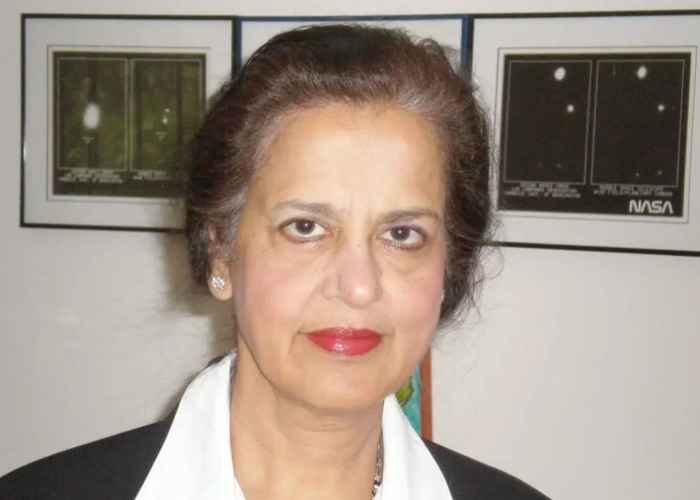
Washington, Feb 19, 2026
A seven-year-old girl in Lucknow stood in her backyard at dawn in October 1957, watching Sputnik streak across the sky. Nearly seven decades later, that child would help steer some of NASA’s most complex space telescopes, from Hubble to James Webb.
“The story starts in October 1957, when I was 7 years old, and my grandmother ordered the entire family, including my 3-year-old sister, all the servants and their families, to collect at dawn in the backyard of the home and watch Sputnik pass by the clear night skies of Lucknow,” Hashima Hasan wrote in a personal account released by NASA on Wednesday.
“That morning, as I saw Sputnik and the dark, starry sky, I dreamt the impossible dream that one day I would be a space scientist.”
Hasan went on to win a scholarship to the University of Oxford, earning a doctorate in theoretical nuclear physics in 1976. “The path to a traditional academic career for a female scientist was fraught with challenges, exacerbated by social pressures,” she said.
After post-doctoral work and a faculty position across three continents, she moved to the United States in 1985 with her husband and two infant sons.
At the Space Telescope Science Institute in Baltimore, she accepted a research position to write software to simulate the optics of NASA’s newest telescope, the Hubble Space Telescope. Under Dr Christopher Burrows, she wrote the Telescope Image Modelling (TIM) software.
“Little did we know that after the launch of Hubble, TIM would be instrumental in our analysis of the first images, the identification and characterisation of the spherical aberration, monitoring the focus of the telescope, and image simulations to enable scientists to analyse their aberrated data,” she wrote.
Hasan was appointed as the Optical Telescope Assembly scientist. She said she had “the dubious distinction of being the first and only OTA scientist whose task was to keep the Hubble ‘in focus’ until a fix could be designed.” Every three months, adjustments were needed to maintain the telescope’s best focus.
“I am proud to be a part of the NASA team that turned adversity to victory. The story of Hubble is a tribute to NASA’s ‘can-do’ attitude,” she said, praising the astronauts who serviced Hubble five times.
In 1994, she joined NASA Headquarters as a visiting senior scientist under Dr Edward Weiler. By 1999, she became a civil servant and was appointed program scientist for Hubble, overseeing key instruments and participating in servicing missions SM3A and SM3B.
Her involvement with the James Webb Space Telescope began in 1995, when it was known as the Next Generation Space Telescope. She later served as NGST program scientist from 1999 to 2001 and JWST program scientist from 2011 to 2015.
She led early technology development and complex negotiations with the European Space Agency and the Canadian Space Agency over the Mid-InfraRed Instrument.
“We were conducting a review of proposals for MIRI management on the fateful day, Sept. 11, 2001. Again, we did not let adversity stop us, and today MIRI and all the other science instruments are installed on JWST,” she wrote.
She called JWST “another example of ‘Explore as One,’ where scientists, engineers, private industry and non-US space agencies have come together.”
“I would like all readers to follow their dreams as I have and not to get discouraged, as we continue exploring the Universe. The sky belongs to all of us,” Hasan said.
Hasan has served as NASA program scientist for multiple missions and as deputy program scientist for JWST.(Agency)
 FOLLOW NOW