New Delhi, Jan 26, 2026
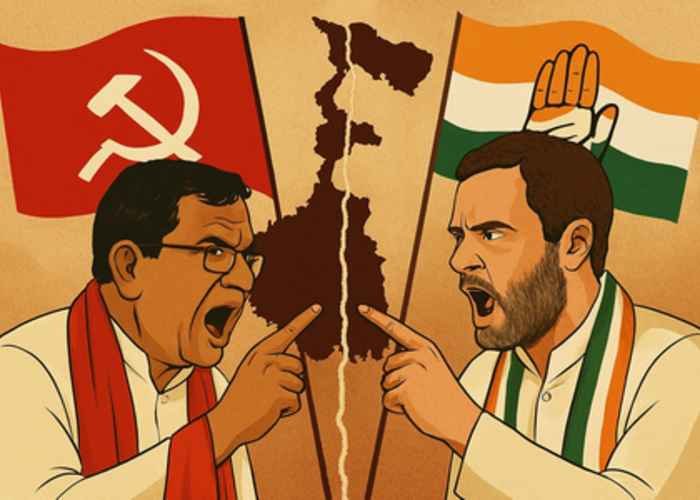
Weeks before the West Bengal Assembly elections are expected to be announced, Congress appears uncertain about another electoral alliance with the Left Front in its bid to form an alternative platform against the state’s ruling Trinamool Congress and Opposition BJP.
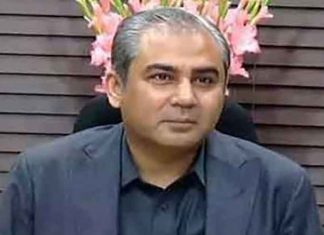
This has drawn sharp criticisms from some of the Left leaders, with Communist Party of India (Marxist) state unit secretary Mohammad Salim reiterating the cry for an alliance.
He has emphasised the need for a strong, grassroots-driven Left-Congress alliance while indirectly urging its partner to decide and commit. He simultaneously criticised both the prospective partner’s hesitation and the Trinamool’s role in West Bengal politics.
In fact, Salim has been openly urging the Congress to make a quick decision on alliance talks. In response, the state Congress leadership recently launched a counterattack, dismissing Salim’s repeated jibes.
“Stop unnecessary interference. Congress will take its own decisions at the right time. We are accountable to the people, not to other parties,” reacted a regional Congress leader on social media without naming the Left leader.
Following such exchanges, the possibility of an alliance further appears uncertain. Earlier, regional tie-ups failed to pull either party out of the political wilderness in the state, both now rendered seatless in the Assembly and the Congress managing a single Lok Sabha seat.
However, at the national level, the CPI(M) has historically failed after leaving the Congress’s hands. The 2004 Lok Sabha elections led to a hung Parliament, where the Congress emerged (145 seats) as the single-largest party, far from a simple majority.
Many political parties, including the Left, agreed to support a coalition government to keep the BJP (138) out of power. In fact, the communists (60) became the anchor of the coalition. But the signing of the Indo-US Civil Nuclear Agreement in 2008 marked a turning point when the Left, particularly the CPI(M), viewed it as compromising its long-standing anti-imperialist stance and suspicion of American influence.
In July 2008, the Left parties withdrew support to the Congress-led United Progressive Alliance (UPA)-I government, leading to a confidence vote in Parliament. This was a decisive moment that weakened the Left’s leverage in national politics.
From its highest peak of 60 Lok Sabha seats in 2004, the Left’s strength fell to just about two dozen in the 2009 Parliamentary election. The fallout exposed the Left’s limited ability to shape national policy.
Their opposition was portrayed by rivals as obstructionist, and the episode contributed to their declining relevance in Indian politics, especially as the Congress managed to survive the trust-vote with new allies.
An all-out fight erupted within the CPI(M) with a clear division between its leaders from West Bengal and Kerala. The former sought to keep the Congress in good humour following the rise of Mamata Banerjee, then aligned with the BJP.
Meanwhile, those from Kerala refused, since regional politics pitted them strongly against a Congress-led alliance. A similar situation exists today. However, in the changed political order, where, after losing West Bengal and Tripura earlier, the Left is now precariously poised in Kerala in the coming Assembly polls, it’s now a Hobson’s choice for them.(Agency)
 FOLLOW NOW